A recent book! A blend of street photography, poetry and academic writing.

More details here:
A Thinking Street Photography Site
A recent book! A blend of street photography, poetry and academic writing.
More details here:
Finally, I’m holding the book in my hands.
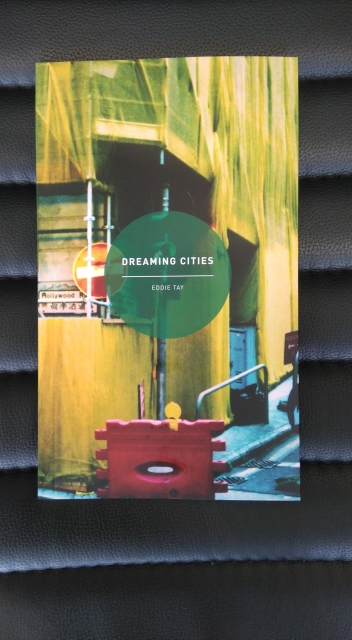
It’s called Dreaming Cities, and it’s a collection of poetry and street photography.
Here’s the blurb: “In this book, poems and street photographs dream of the modern city, laying a poetic geography over the urban landscapes of Hong Kong and Singapore.”
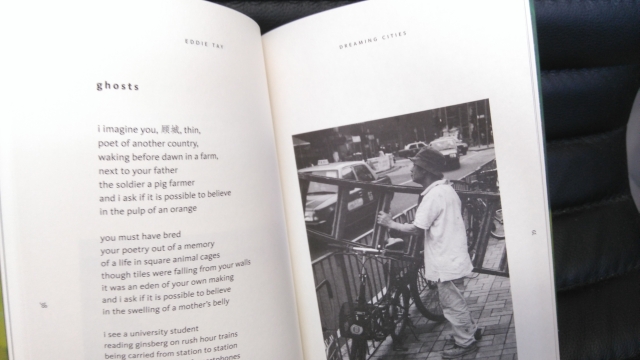
It’s been fun working with Math Paper Press, my publisher.
They’re a pretty happening group – Math Paper Press is an imprint of BooksActually, the bookstore to go to if you’re interested in Singaporean literature and art scene.

They work with Sarah and Schooling, the graphic design studio responsible for the design of MPP’s gorgeous books.
As any book lover knows, a book is a tactile object. It has to look, feel and smell right.
Math Paper Press and Sarah and Schooling know their stuff.
Here’re some photos of the exhibition opening and setup.

It’s nice of them to make available the exhibition posters and invitation cards as takeaways for guests.

My initial concern was the number of photographs (and hence the display boards) relative to the size of the venue but it turned out to be alright. It’s not too sparse and not too cramped.

I’m grateful to Prof. Victor Chan, Head of Chung Chi College, for opening the exhibition. He’s a composer and conductor and so understands what it means to be immersed in one’s art.
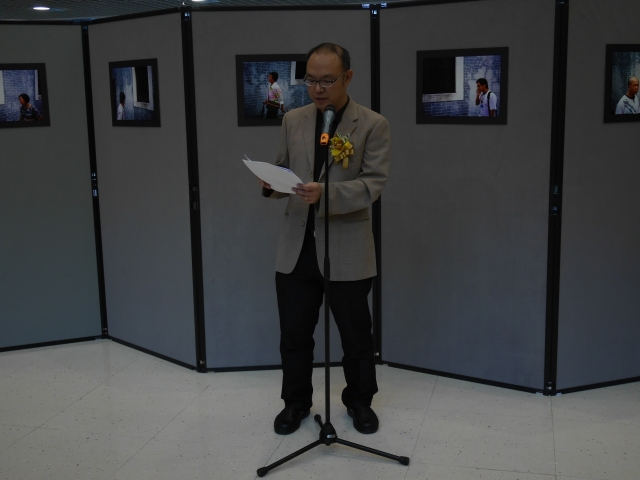
I got to read a few poems. Some of those photographs will be published alongside their accompanying poems in a related book project next year.

It’s a different feeling – having physical prints exhibited, as opposed to looking at images on a screen.

I did get into a few conversations about my choice of subjects.

I organized the photographs in terms of colour vs monochrome, as well as themes (rural, urban, indoors, outdoor, traffic, streets, etc).

I’d admit to feeling nervous when I saw a few people scrutinizing those prints closely…
The exhibition runs for a month and will close on 4th Dec 2015.
Do come by if you’re in the area!
Many thanks to R and K for taking the photos!
My gratitude to R and her colleagues for mounting those photos onto the boards!
Here’s a mishmash of images of Singapore, significant to myself.

Though the underlying theme here is about how we try to snatch something beautiful out of what is essentially functional.
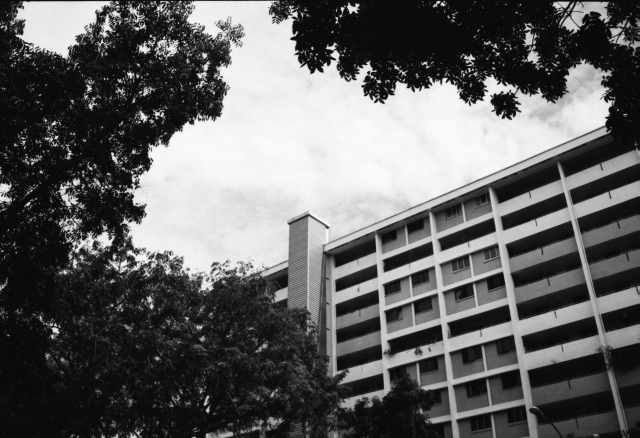
Form follows function in much of Singapore.

Life, too, follows function: poetry is a luxury we cannot afford.

There is one way only. The rest is barred.

If you live with it long enough, it becomes beautiful.

Draw the curtains.

Poetry delayed is poetry denied.
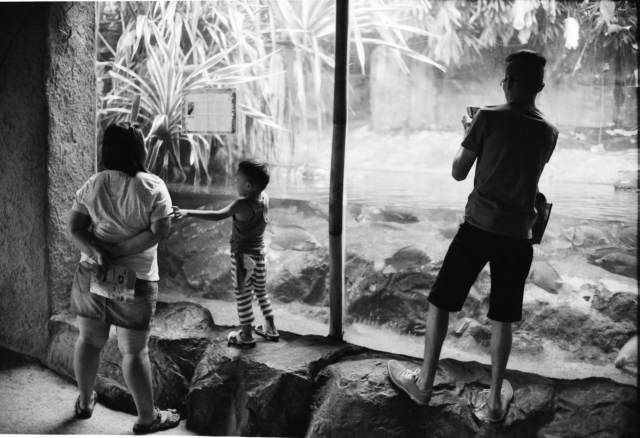
We are at the zoo.

The helpful tram driver and a passenger.
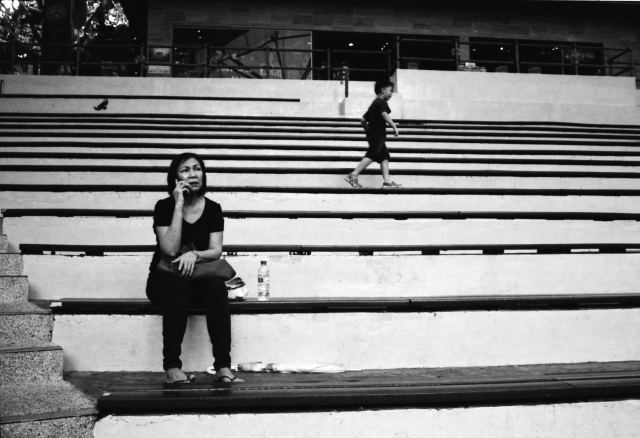
After the animal show – poetry is found after the event.
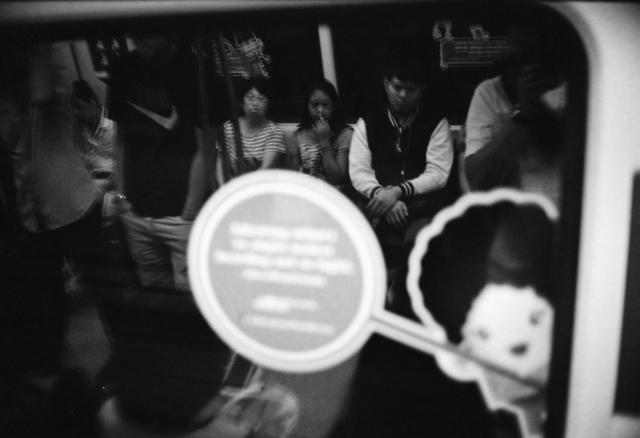
Reflections in the MRT.

The tree is obedient, bent in the wind.
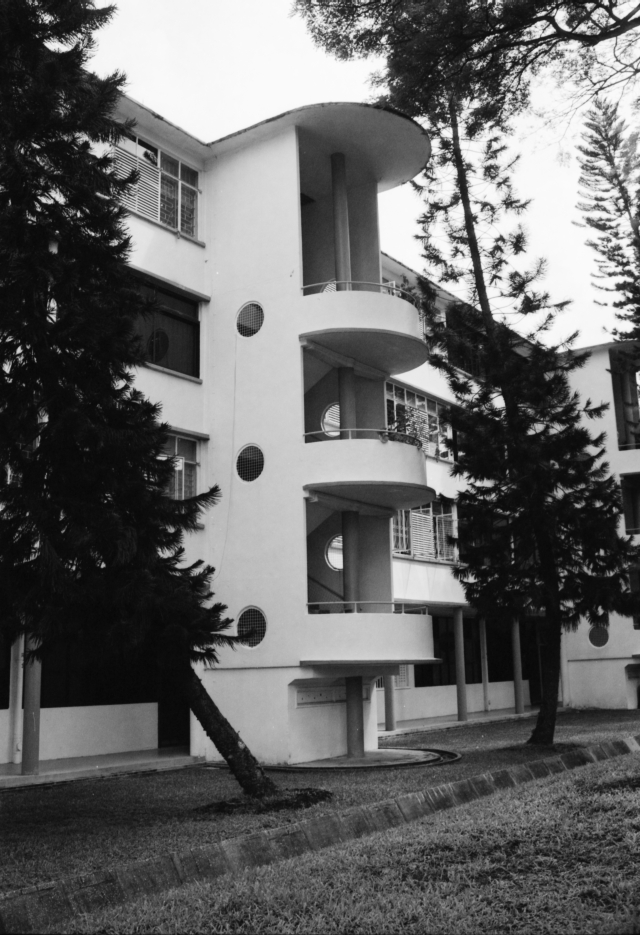
Perhaps something is poetry after all…
Thanks for reading.
Camera: Leica M6
Lens: Voigtlander 35mm f 1.4 Nokton SC
Film: Ilford XP2
Some time ago at Sham Shui Po, I saw them:


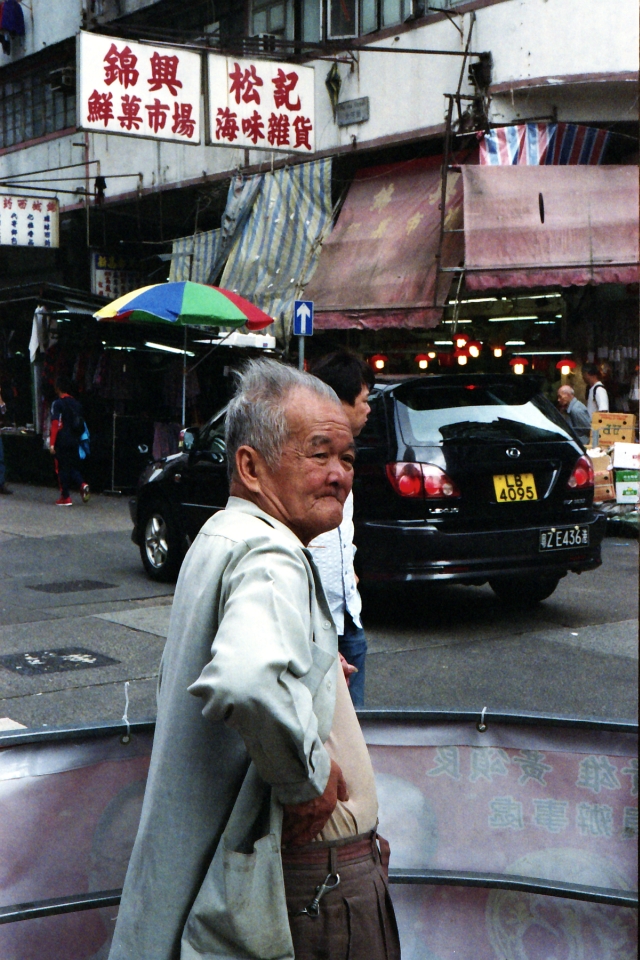
In Wikipedia’s entry on “Sham Shui Po”, you see this sentence: “Sham Shui Po is an area where urban decay is serious in Hong Kong.”
It is easy to call this documentary photography, in the sense that these are pictures that serve as evidence of social categories such as “urban decay”, “poverty”, “old age”, etc, etc.
It’s hard to see otherwise, but sometimes I think we see things only as we can. Classification is easy because it means you’ve “mastered” the world and have successfully explained what you see to yourself.
At times, though, I could see them as people like myself, living their lives just as I am living mine …
I’ll just end here with the beginning of a poem I’ve been living with for quite some time…
— The Man with the Blue Guitar — (by Wallace Stevens)
The man bent over his guitar,
A shearsman of sorts. The day was green.
They said, “You have a blue guitar,
You do not play things as they are.”
The man replied, “Things as they are
Are changed upon the blue guitar.”
And they said then, “But play, you must,
A tune beyond us, yet ourselves,
A tune upon the blue guitar
Of things exactly as they are.”
I’m prepping for a talk on my manuscript in progress which features street photography and poetry.
In some ways, the camera has become my sketchbook.
Here’s Henri Cartier-Bresson from The Mind’s Eye (and the first part of the book is titled “The Camera as Sketchbook”):
For me the camera is a sketch book, an instrument of intuition and spontaneity, the master of the instant which, in visual terms, questions and decides simultaneously. In order to “give a meaning” to the world, one has to feel oneself involved in what one frames through the viewfinder. (The Mind’s Eye pg. 15)
For the street photographer, the camera is a tool for thinking …
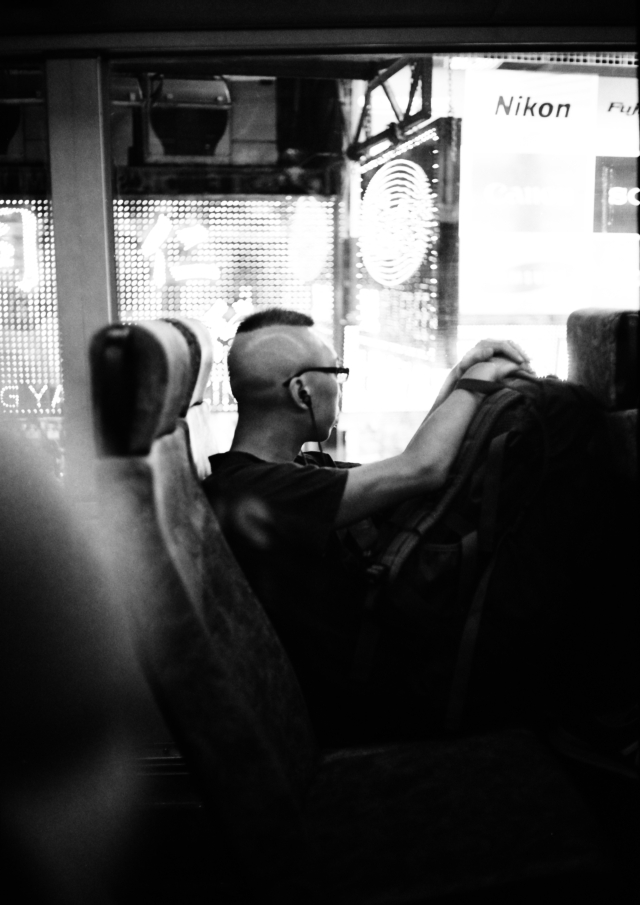
Here are some of the photographs I’ll be talking about, the first of which has been featured in a previous entry.
They are each paired with a poem in the manuscript.
I’m only including fragments of the accompanying poems here.
*
“how hong kong works, no one knows,
though everyone says mm goi, mm goi,
thank you, small favour, another name
for waiter, excuse me, help.”
*

*
“one can only be a tourist
constantly taking pictures
posing and making sense”
*

*
“i tell myself i am a camera
though i am a camera trying to be a man
because a camera captures everything
and is nothing in itself.”
*
What they have in common: they’re about looking at the act of looking. In a way, these are photographs of myself…
Thanks for reading.
Photography is … visual. That much is obvious. As a published poet and literature professor, I’m supposed to be able to convey ideas with words but what happens when something is a visual idea?
This would take us from visual to verbal to visual again. And the first and last visual may not be the same, even though we’re talking about the same photograph.
I look and look and understand how a photograph works, but I’ve yet to properly learn how to say why it works and why I enjoy it.
Photography has made me rethink some of those things to do with literature that I’ve forgotten. Of course, the experience of a literary work is not the same thing as a book review or a scholarly paper.
The experience … the experience … the horror … the horror … the “oomph” … it starts with the experience, and sometimes I feel like all one has to do is to read and look and be quiet. That was the experience of reading in my youth which put me on the path of academia.
The subjective “oomph” comes first. All the bits about literary/intellectual history, the meaning of meaning and so on, comes after.
This explains why my colleagues down the corridor could spend so much time on books that I genuinely find boring and pointless … and of course, vice versa.
Anyway, back to what is visual “oomph”, at least for me:
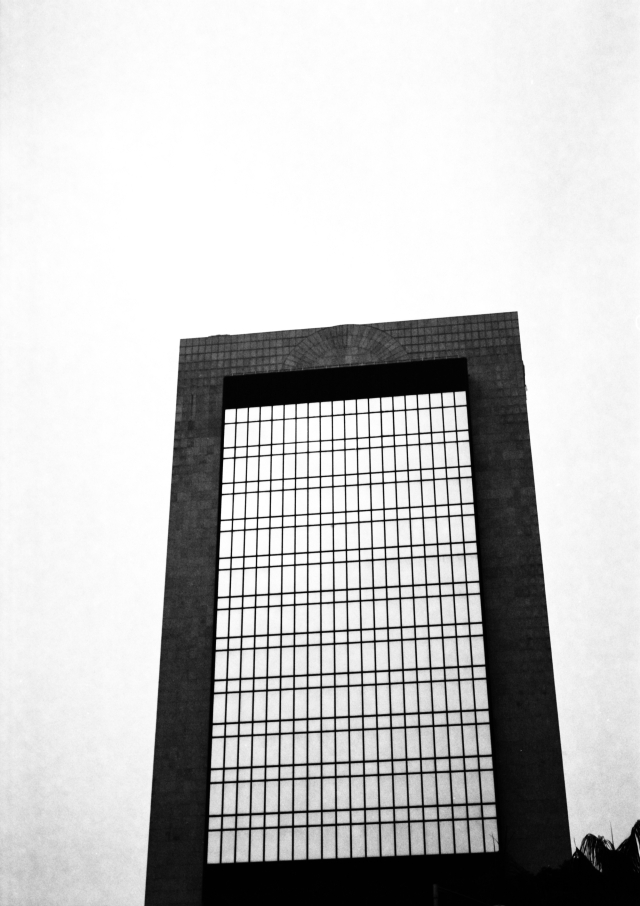
That’s the Leisure and Cultural Services Headquarters at Shatin. Perhaps this is what the Ministry of Truth looks like in Orwell’s 1984.

The mini-bus and high-rise apartment buildings. So very Hong Kong. This is at the elevated bus interchange just outside New Town Plaza, the hard-to-miss shopping mecca at Shatin.

Walk down the sloped pavement by the side onto ground level and you’ll see an entire length of village houses, some of which have been converted into eateries.

That’s just below the bus interchange, right next to more mini-bus terminal stops. I like the different greys of the pavement…

Yet another village house … with a gothic feel.
All these images are taken from within 200-300 metres. That’s how packed Hong Kong is. Keep in mind this is the urbanised area of the New Territories, third in line in terms of urban development, coming after the Kowloon/Tsim Sha Tsui areas and the Central/Wanchai areas on Hong Kong Island.
Thanks for reading.
 Hong Kong Lucida