Blog

Street Market and Printing

Though all the images here are created with film cameras, they are of course scanned from negatives and ultimately, on display here are digitised images on a computer monitor.
IMG_20130913_0002 A3 adjusted A4 640

I’ve been experimenting with colours lately, having bought a dedicated pigment ink photo printer and various Ilford and Harman papers.

It really does make a difference whether the image is printed on glossy or on matte, etc. And of course, I am going to frame them up, now that I’ve finally gotten my hands on photo-safe tape.

Images like the one below work on both matte and gloss. On matte, there is a gritty look which fits in with the grungy seat-of-the-pants attitude of street photography.

IMG_20130913_0001 adjusted A3 A4 640

A colleague who used to paint commented that the matte print looks more like a painting than a photograph. He said there’s a Caravaggio framed-by-darkness quality to it.

On the other hand, the glossy print has what I think of as a “Nirvana in Carnegie Hall” effect… a refined “fine art” treatment to street photography.

IMG_20130913_0001_ adjusted A3 A4 640

I suppose glossy is good for portraying drama in ordinary scenes.

And now that I’ve got all of these, I’m now thinking of what I should do next. Where is this taking me?

Direction 1: Teaching and Research

A fascination with photography (and film cameras, I must admit) is now changing the way I work. I find myself making connections between photography and creative writing, between the history of art and literary history. Is there a homology between creative writers and photographers?

What would a university course on the connections between photography and literature look like?

I am now thinking of creating a course that is practice-based, one that encourages students to go out and explore HK culture using literary and non-literary writing and photography, and getting them to think about what constitutes valuable cultural knowledge.

I’ll probably throw social media (such as a WordPress blog like this) into the mix, getting them to think about the use of social media for sharing one’s work. And what is meant by “sharing”? What, really, is being shared? And what is “work”?

Direction 2:

This has all to do with the situation of one’s work, I suppose. Digital images live in one’s hard disks or are displayed on sites like this. Now that I have the physical prints on hand, perhaps the next step is to work towards a gallery exhibition.

It’s a kind of curating, I suppose, setting up one’s work for viewing …

IMG_20130906_0006 A3 adjusted A4 640

What kind of logistics and various other considerations would this involve? There’s a learning curve ahead of me …

What is becoming clear to me now though, is that this blog is like a thinking-in-progress technology, a depository of raw ideas… much like a building under construction …

IMG_20130913_0003 adjusted A3 A4 640

Thanks for reading.

Ode to Public Laundry

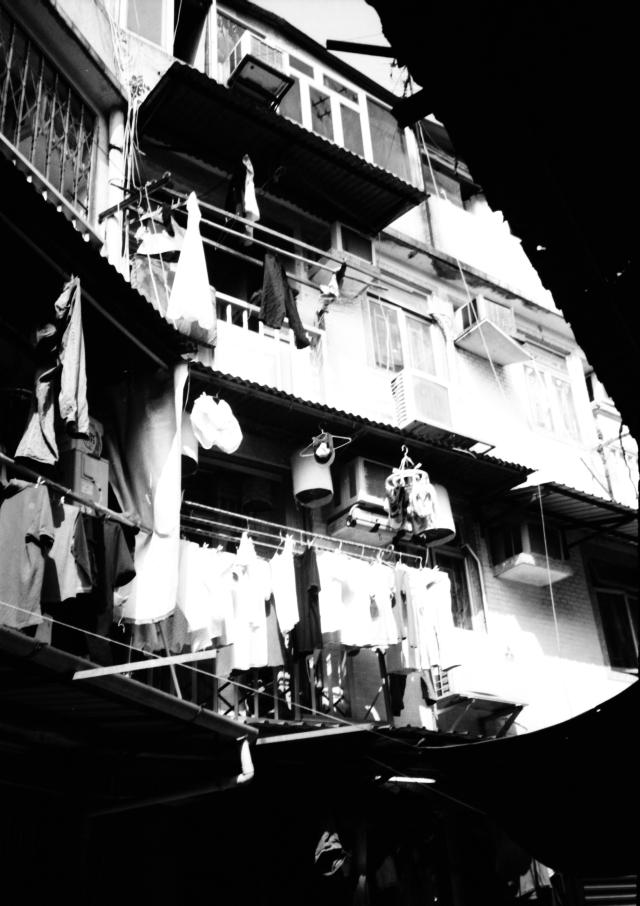
I guess this is a common sight in quite a few places in Hong Kong:

IMG_20131010_0038 A3 A4 640

On the one hand, there are those who say this is unsightly, and that there should be awareness campaigns against airing/drying one’s laundry in public.

After all, it looks too much like a ghetto, and is offensive to middle-class tastes.

(It might bring down property prices.)

IMG_20131010_0043 A3 A4 640

On the other hand, it speaks of the “can do” spirit of people, who make do with tiny living spaces in Hong Kong.

There is a kind of symphony here of public laundry.

IMG_20131010_0039 A3 A4 640

There is a kind of charm in the way the clothes are being hung… perhaps there is a sense of community here in the way the space is being shared.

Not everyone has dryers at home… and after all, clothes dried in the sun has the smell of sunshine in them.

IMG_20131010_0062 A3 A4 640

And sometimes, it can get a little creative:

IMG_20131008_0044 A3 A4 640

There are public spaces. There are private spaces.

And perhaps there are in-between shared social spaces with streets that are peopled even if there are no people around…

Monochrome Poetry

Photography is … visual. That much is obvious. As a published poet and literature professor, I’m supposed to be able to convey ideas with words but what happens when something is a visual idea?

This would take us from visual to verbal to visual again. And the first and last visual may not be the same, even though we’re talking about the same photograph.

I look and look and understand how a photograph works, but I’ve yet to properly learn how to say why it works and why I enjoy it.

Photography has made me rethink some of those things to do with literature that I’ve forgotten. Of course, the experience of a literary work is not the same thing as a book review or a scholarly paper.

The experience … the experience … the horror … the horror … the “oomph” … it starts with the experience, and sometimes I feel like all one has to do is to read and look and be quiet. That was the experience of reading in my youth which put me on the path of academia.

The subjective “oomph” comes first. All the bits about literary/intellectual history, the meaning of meaning and so on, comes after.

This explains why my colleagues down the corridor could spend so much time on books that I genuinely find boring and pointless … and of course, vice versa.

Anyway, back to what is visual “oomph”, at least for me:

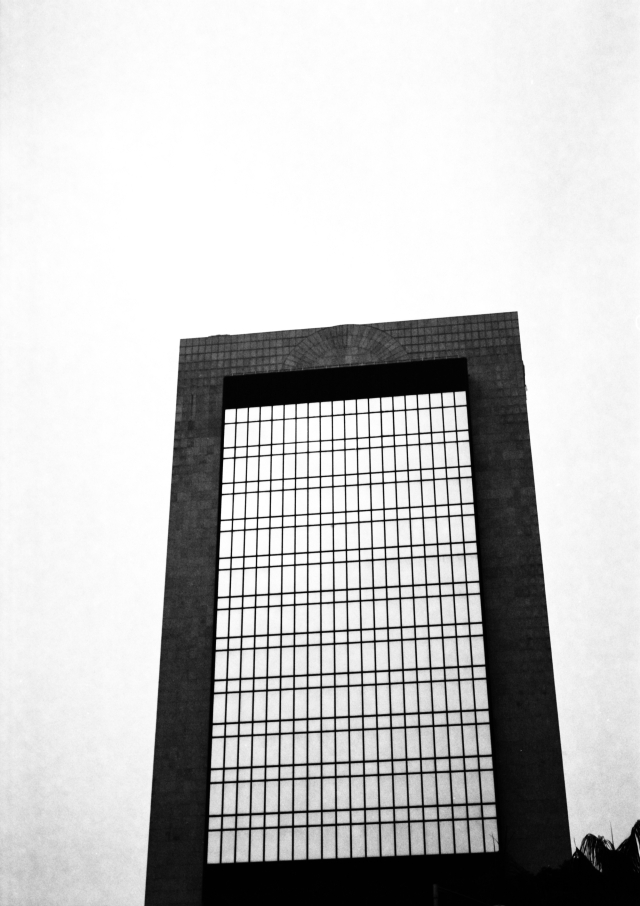
IMG_20131008_0019 A3 A4 640

That’s the Leisure and Cultural Services Headquarters at Shatin. Perhaps this is what the Ministry of Truth looks like in Orwell’s 1984.

IMG_20131008_0008 A3 A4 640

The mini-bus and high-rise apartment buildings. So very Hong Kong. This is at the elevated bus interchange just outside New Town Plaza, the hard-to-miss shopping mecca at Shatin.

IMG_20131008_0020 A3 A4 640

Walk down the sloped pavement by the side onto ground level and you’ll see an entire length of village houses, some of which have been converted into eateries.

IMG_20131008_0023 A3 A4 640

That’s just below the bus interchange, right next to more mini-bus terminal stops. I like the different greys of the pavement…

IMG_20131008_0021 A3 A4 640

Yet another village house … with a gothic feel.

All these images are taken from within 200-300 metres. That’s how packed Hong Kong is. Keep in mind this is the urbanised area of the New Territories, third in line in terms of urban development, coming after the Kowloon/Tsim Sha Tsui areas and the Central/Wanchai areas on Hong Kong Island.

Thanks for reading.

Fa Yuen Street Market

Night photography poses a challenge for any photographer.

Even with a digital camera, you’ll need a wide aperture, longer exposures, perhaps a tripod, or image stabilization if you’re doing it handheld, and you’ll need to have a high ISO setting.

Auto-focus might be a problem if it gets too dark, as a digital camera may not be able to find a focal point quickly enough.

So if you’re a street photographer with a film rangefinder loaded with Ilford XP2 at ISO 400, the odds are somewhat stacked against you at night. This is one of those times when you wish you’d caved in and bought that Fuji X100s.

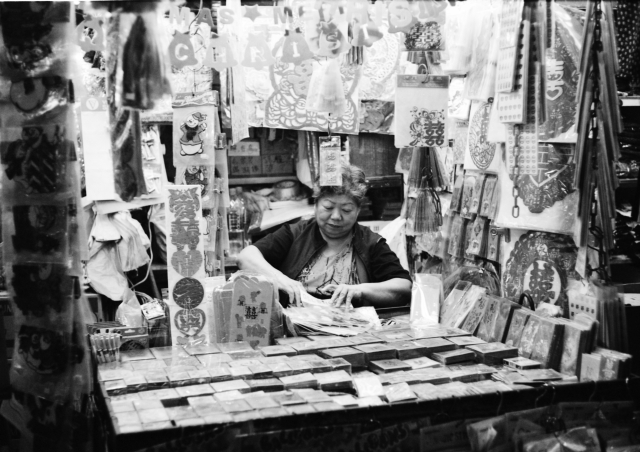
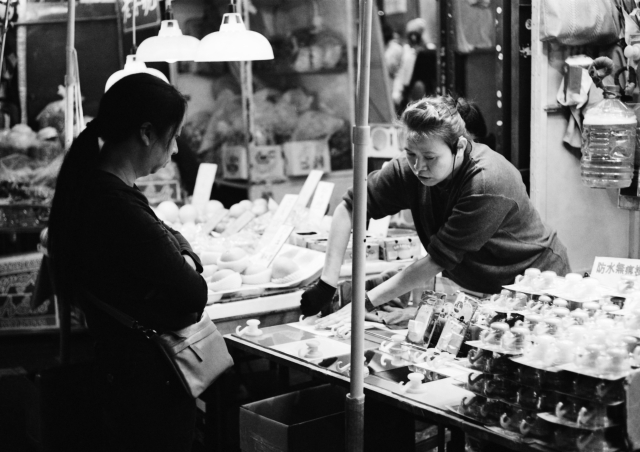
A street market at night, as it happens, is one of those wonderful scenarios where everything comes together.

As the light bulbs are bright, you’ll have natural vignetting. The goods might have been arranged to form a perfect frame within a frame.

IMG_20130918_0010 A4 640

IMG_20130918_0013 A4 640

The stall hawkers, even when they spot you, would be too preoccupied with selling their wares to their customers, while the customers’ attention would be on those wares.

IMG_20130918_0012 A4 640

IMG_20130918_0011 A4 640

IMG_20130918_0005 A4 640

This person did spot me…

IMG_20130918_0003 A4 640

Oh well … and to challenge myself, this:

IMG_20130918_0015 A4 640

Thanks for reading.

Grids, lines and colours

I’m now convinced that Hong Kong is a street photographer’s paradise.

I’ve been paying attention to grids, lines and colours and it seems to me that all I have to do is wait a little bit and the composition would fall into place after a while.

Mongkok is rather good for that sort of thing.

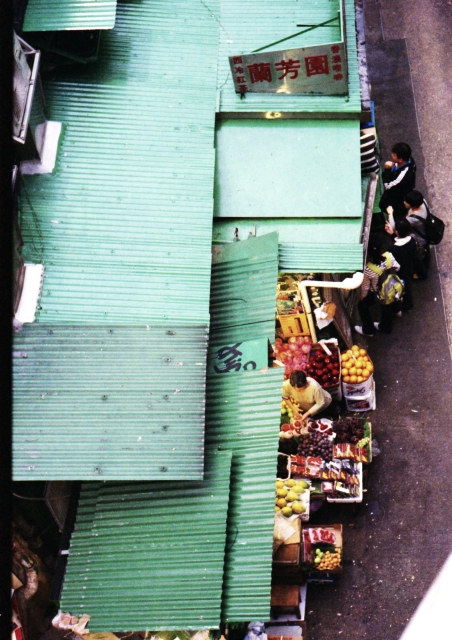
For example, the rectangular green grids of this candy store window has a lomography edge to it, and all I had to do was to memorise where the framelines of my beloved Leica M6 would be and wait until someone walks into the frame. Check out the reflections and the Chinese characters – they’re there and yet not so overwhelming:

IMG_20130906_0003 A3 adjusted A4 640

The diagonal lines were calling out to me as I was on a bridge:

IMG_20130906_0002 A3 adjusted A4 640

And finally, I like the grungy and yet contemplative mood this evokes:

IMG_20130906_0002 640

And I’m keeping a close watch on my diminishing supply of Kodak Portra 400 film with which these were taken…

Thanks for coming by today.

near Ma On Shan Central Park

Adjacent to Ma On Shan Central Park, facing Tolo Harbour, is a homely stretch.

On a leisurely weekend, you’ll find joggers, sunrise/sunset photographers and people simply out for a walk.

IMG_20130311_0012 640 by 480

I’ve underexposed these shots, and realized one could transform the homely and familiar into something uncanny, slightly gothic and perhaps even frightening.

IMG_20130311_0027 640 by 480

I think it has to do with seeing and not being able to see. Simply by playing with light, one could change things.

IMG_20130311_0015 640 by 480

That is why I think street photography is about “capturing” as much as constructing and playing with reality.

IMG_20130523_0040 640 by 480

Boo!

Ode to Retail

I don’t usually do color photography as I find it hard to “coordinate” the colors alongside the action in the frame. But the environment in this case seems to call out for it.

This was the beginning of a trip to Festival Walk, a shopping mall. My son wanted to pick up a few books at Page One. We sat at the front of a mini-bus.

IMG_20130827_0009 640 by 480

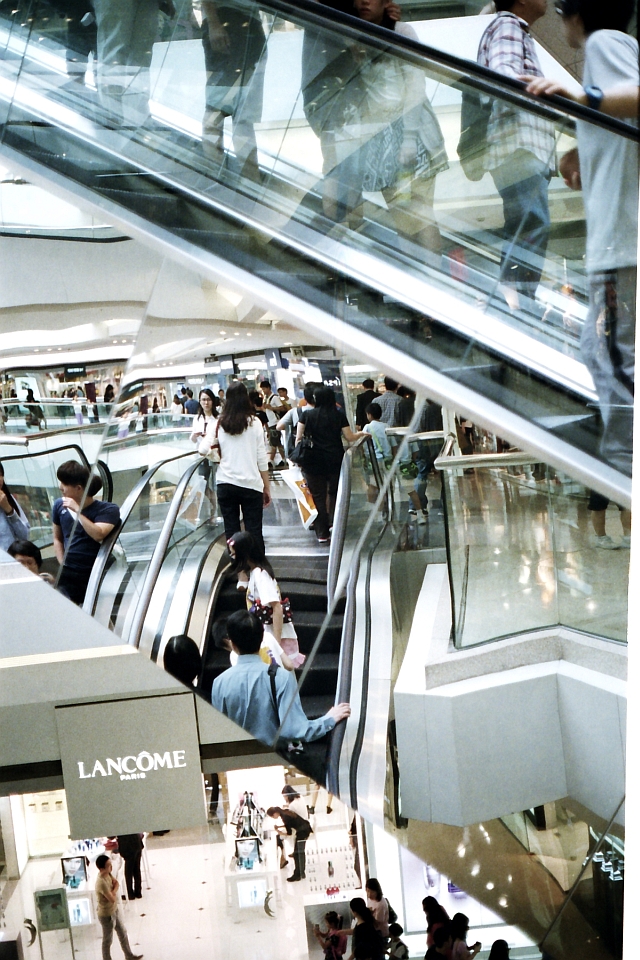
For those not familiar with Hong Kong: Festival Walk is a gigantic shopping mall with a skating rink and cinema. I often got lost the first few times I was here.

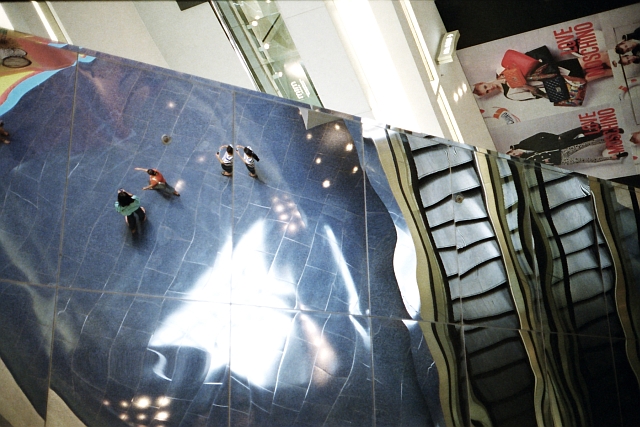
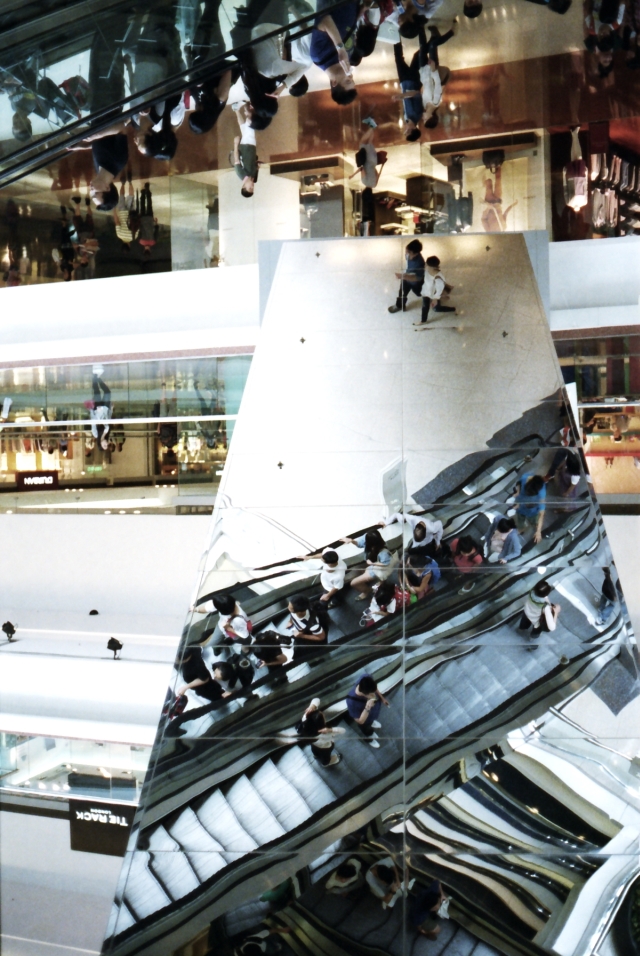
There are so many escalators and reflective surfaces. There is a fun house mirror effect every time we are on the escalators:

IMG_20130827_0025 640 by 480

We forget which way is up and which way is down…

IMG_20130827_0032 640 by 480

I think this is the point, that the design of malls are slightly disorienting so that the shopping experience feels slightly unreal. Our ability at making rational choices are somewhat incapacitated – we lose track of time and spend more than we had originally intended.

IMG_20130827_0034 640 by 480

I am reminded of a hotel called “Lotus Casino” in The Titan’s Curse, a novel in the Percy Jackson series, in which the characters were trapped. They were reluctant to leave the hotel because it was so fun. (The environment of casinos, of course, are meant to be unreal so that the chips [money] you’re losing look inconsequential anyway because you are just playing a game of Monopoly.) I’m thinking of those casinos in Macau now, especially the Greek Mythology Casino, complete with a gigantic statue of Zeus…

Here, the literary scholar in me is reminded of Fredric Jameson’s discussion of the Westin Bonaventure Hotel, about how the postmodern architecture is tied in with the (totalitarian?) logic of late capitalism.

It’s so easy in the mall. We look and point and buy:

IMG_20130827_0035 640 by 480

Everything is on show and so very photogenic, and the unreal becomes part of the experienced reality we consume and hence take for real:

IMG_20130827_0028 640 by 480

I almost forgot to leave.