Stories and Things

We can’t help but tell stories.

There’s a story to be told here about directions, linearity and tension.

IMG_20140320_0012 640

And here about the value we give to things.

IMG_20140320_0022 640

Here, we see possibilities…

IMG_20140320_0025 640

And here, we read.

IMG_20140320_0027 640

Is this an image of ourselves, caught living in our own fish tanks?

IMG_20140320_0031 640

Is this where we go in the end?

IMG_20140320_0032 640

Or is there someone upstairs, waiting for us?

IMG_20140320_0044 640


The Artistic Process: On Being in the Zone

Street photography can get addictive.

Sometimes it’s the challenge, because you’re setting yourself up to be unobtrusive.

IMG_20140320_0021 640

My cameras are all very small. My Minolta AF C and Olympus XA 2 look like plastic toys so people don’t take me seriously even when they spot me.

Sometimes you want to be spotted. It adds drama to the scene.

IMG_20140320_0071 640

Sometimes you’re right in their faces but they can’t be bothered … this man saw me with my camera pointing at him and went on doing what he was doing…

IMG_20140320_0041 640

I get out and walk and get “in the zone”. It’s a subjective (but common enough) experience.

For me, it happens when I’m writing or reading or when I’m teaching, when I’m fully immersed in the experience without any sense of self-consciousness.

In “Tradition and the Individual Talent”, one of my favourite essays on writing poetry, T. S. Eliot wrote (among other things) on the artistic process:

What happens is a continual surrender of himself as he is at the moment to something which is more valuable. The progress of an artist is a continual self-sacrifice, a continual extinction of personality.

And he goes on to say:

Poetry is not a turning loose of emotion, but an escape from emotion; it is not the expression of personality, but an escape from personality. But, of course, only those who have personality and emotions know what it means to want to escape from these things.

Writing, reading, teaching, and street photography are ways of getting myself outside of myself. It’s a way to silence that inner voice at the back of my head so that I’m not second guessing and talking to myself all the time.

IMG_20140320_0023 640


IMG_20140320_0067 640

Anyone who wants to be good at what he or she does (especially though not necessarily in the field of the arts) ought to read Flow: The Psychology of Optimal Experience and Creativity: Flow and the Psychology of Discovery and Invention by Mihály Csíkszentmihályi.

He uses the word “flow” to describe that happy state of being engaged in endeavours such as artistic creation, athletics, scientific tinkering, and so on, to map out relationships between learning, enjoyment and satisfaction.

It’s rather “pop psychology”-ish, but it’s very enabling in terms of helping me think about art creation in a wholesome way, in a way that is opposite to that image of the tortured artist celebrated by the media. Van Gogh, Diane Arbus and Sylvia Plath – the list goes on.

But surely there’s also room for artists/writers who want to be productive and remain sane… there’s Henri Cartier-Bresson, who deliberately moved away from photography to take up painting later in his life, there’s Wallace Stevens, poet and vice-president of an insurance company, who was productive as a poet all the way till his death in his seventies.

IMG_20140320_0050 640


IMG_20140320_0074 640

I get out of myself and look at other people and think about what it is that occupies them…

This man, for instance, stood just like this for a really long time, looking at a building across the road.

I took some time to frame the scene properly, and turned around later and saw there were bemused people looking at me looking at him…

IMG_20140320_0125 640

Everywhere we go, we bring along a baggage of impulses, desires, anxieties, ambitions…

IMG_20140320_0092 640

Maybe one day I’ll get caught and someone would tell me to grow up and that this is not a proper use of my time…

IMG_20140320_0091 640

Appetites, Things, Phantasmagoria

I was just looking through a few images taken on an evening at Fa Yuen Street and on an afternoon in the vicinity of Shamshuipo.

There is that contrast that plays with visibility and lack thereof.

IMG_20140320_0056 640

We see people emerging from darkness.

IMG_20140320_0064 640

We see hands and appetites but not always faces.

IMG_20140320_0066 640

We are reduced to silhouettes of ourselves.

What defines and frames our activities are appetites and things…

IMG_20140320_0029 640

IMG_20140320_0076 640

IMG_20140320_0016 640

Our appetites and things have become substitutes for our selves … that is how a city becomes a kind of phantasmagoria….

How to Analyse and Appreciate Street Photography Without People

I like the following passage by James Elkins:

Every field of vision is clotted with sexuality, desire, convention, anxiety, and boredom, and nothing is available for full, leisurely inspection. Seeing is also inconstant seeing, partial seeing, poor seeing, and not seeing, or to put it as strongly as possible … seeing involves and entails blindness; seeing is also blindness. (Elkins The Object Stares Back 95)

Even though everything is right in front of us, we see that we do not see.

Street photography is about the human condition.

When street photographs are devoid of people, we are reminded powerfully of what we do not see.

It’s the same as telling you not to think of pink elephants –  the moment you hear the command, you can’t help but think of pink elephants.

IMG_20140320_0062 640

The above scene is moulded by desire, and it calls out for a kind of associative thinking that is different from our everyday calculative, economically disciplined thinking.

It’s as if to say every day is a surrender of our selves.

Those in pain will know: there are so many ways to suffer, and in our suffering, many ways to call for help.

IMG_20140320_0078 640

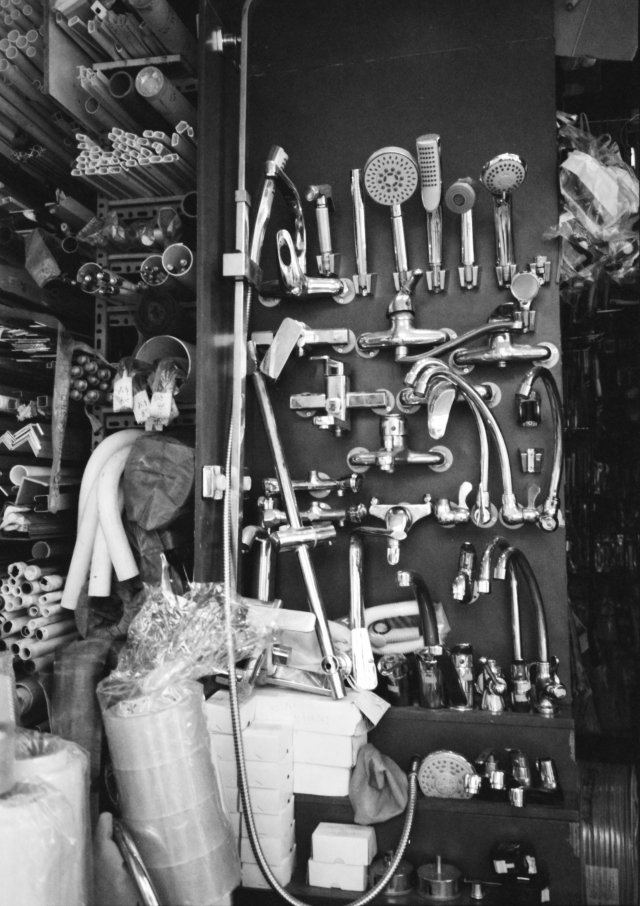
Monochrome photography eliminates colours that may be distracting.

Here, our attention is drawn to multiplicity and repetition.

What the above says to me: there are many shoes for sale. You can buy any pair or more than a pair.

But you could only walk in your own pair.

IMG_20140320_0084 640

We’re asked to think in terms of symbols.

What does the electric meter symbolise?

For me, the photograph is asking the following questions: how much have we accomplished? Is there any one to keep track?

Where is the electricity meter of our days? Where is the electrician?

Is the photograph asking those questions, or am I the one asking?

Perhaps the photograph and I are one.

IMG_20140320_0119 640

What’s the writing on the wall?

Translation: one, peace.

It’s up to you to fill in the blanks between those words.

IMG_20140320_0120 640

Why would anyone put a sofa on the pavement? I asked this as I took this photograph.

I have been at this spot many times and it’s still here. On some days, it’s occupied.

On others, not.

An empty sofa is like a funeral of the self.

IMG_20140321_0008 640

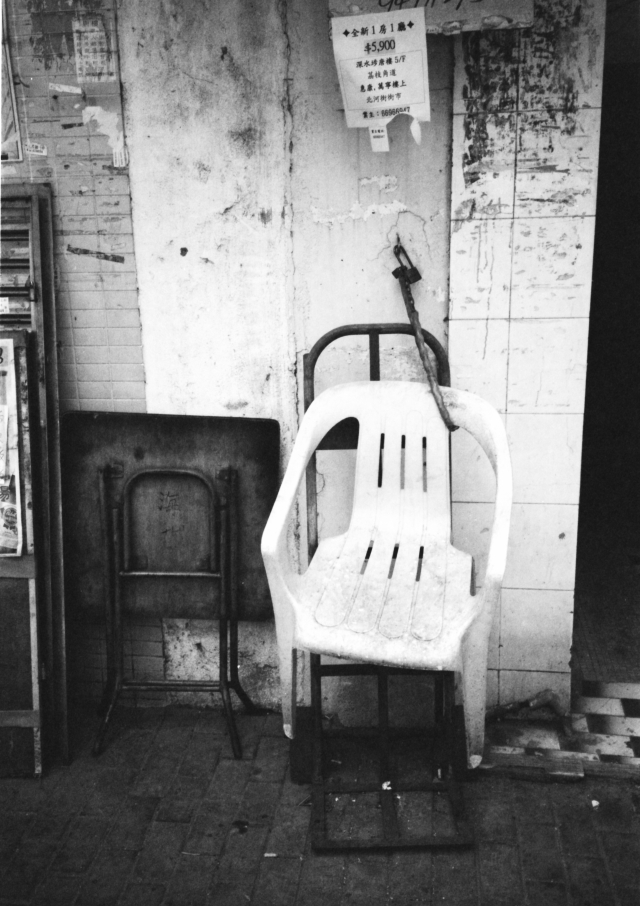
Whoever placed the chairs here is smart.

Things are different with two chairs.

There are possibilities here.

IMG_20140321_0002 640

We build and dwell … and soon the evening is here.

IMG_20140321_0003 640

We pack up the boxes of our days…

Will they be enough?

Am I enough?

IMG_20140321_0001 640

Is it already time to move on?

Susan Sontag vs John Berger

I am presenting a paper on photography and literature at an academic seminar next Monday at Hong Kong Baptist University, and this is part of what I am going to say:

IMG_20130724_0011 640

This is what Susan Sontag says about photography:

like many mass art form, photography is not practiced by most people as an art. It is mainly a social rite, a defense against anxiety, and a tool of power … Photographs document sequences of consumption carried on outside the view of family, friends and neighbors … Travel becomes a strategy for accumulating photographs. (On Photography)

I am thinking of people I know who like to photograph their food before they eat, or of parents who take photographs of their children while they’re playing the piano at home or of their families in front of the Eiffel Tower. There’s nothing wrong with doing these things (I do them myself all the time), but after a while, if we claim to be serious about photography as an art form and yet this is all we do with photography, then it no longer allows us to see anything new. It allows us to see only what we already see, putting us in a state of self-consuming and self-affirming narcissism, saying, “Look at me, look at me”.

IMG_20130813_0014 640

But a lot of what Sontag says are provocations to thought as well:

Photography implies that we know about the world if we accept it as the camera records it. But this is the opposite of understanding, which starts from not accepting the world as it looks. (On Photography)

What if we pursue photography with humility, as a way of looking at things differently? John Berger has made the point that “Every photograph presents us with two messages: a message concerning the event photographed and another concerning the shock of discontinuity” (Another Way of Telling).  He goes on to say that “Between the moment recorded and the present moment of looking, there is an abyss” ((Another Way of Telling).

IMG_20130724_0026 e 640

The abyss is when the street photograph gives us something we find hard to accept. We look, and look again, and we struggle with the meaning of the scene.

IMG_20130724_0025 640

Perhaps, then, this is the moment we enter into the realm of critique…

IMG_20130724_0012 640

Searching for Singapore III

I suppose this theme is like a visual fixation for me.

This post is dedicated to those who know what it feels like to be doing street photography in your own neighbourhood.

In our own ways, we’re all searching for something, using our cameras as visual search engines.

What are we looking for? For another way to look, to turn everything into a work of art…

IMG_20140310_0006 640

I suppose it’s about moments that surprise me.

IMG_20140310_0002 640

That tree now looks like an explosion with the HDB flat facade as backdrop…

IMG_20140310_0022 640

I keep coming back to HDB flats (public housing that 80-85% of Singaporeans live in), because it’s the cookie-cutter, middle-class, ideological environment I grew up in and which is part of who I am.

IMG_20140310_0001 640

For those looking for general info concerning public housing in Singapore, this article from Wikipedia is a good general source. You could purchase these (highly-subsidised) flats through various schemes which are generally pro-marriage, pro-family, pro-heteronormative, etc.

IMG_20140310_0013 640

It’s all very Bauhaus-influenced, with a rational/functional ethos to it.

Chua Beng-Huat, a sociologist at NUS, has a wonderful book called Political Legitimacy and Housing: Singapore’s Stakeholder Society. It looks at the ideological and social-engineering aspect of Singapore’s public housing policy.

I’m fascinated by how newness can emerge from familiar/regimental environments.

I have a thing with hawker centre food …

IMG_20140310_0016 640

These are some people I’m learning to see again with my camera.

IMG_20140310_0015 640

IMG_20140310_0023 640

These were all taken on the same day I was due to go back to Hong Kong.

At the airport … back to Hong Kong…

IMG_20140310_0019 640

Is Hong Kong any different?

IMG_20140310_0031 640

IMG_20140310_0026 640

IMG_20140310_0034 640

In the end, it’s all about finding your place, moving up or down…

I should say all of images here are from the same roll of film: Ilford XP2 in an Olympus XA2.

The Leica M6 is now my back up camera (!!!)

Thanks for reading!

Quiet Rural Hong Kong

Mention Hong Kong and you would think of skyscrapers, crowded streets, and the wonderful dimsum.

But there’s a quieter, meditative side to Hong Kong as well.

IMG_20130523_0041 dpp 640

You could find scenes like these…

IMG_20130523_0018 dpp 640

IMG_20130523_0019 dpp 640

These are the views you get if you’re willing to live in somewhat out-of-the-way village houses.

IMG_20130523_0031 dpp 640

IMG_20130523_0033 dpp 640

These are really quiet, meditative spots.

IMG_20130523_0035 dpp 640

IMG_20130523_0036 dpp 640

If you’re willing to live near a farm…

IMG_20130523_0030 dpp 640

IMG_20130523_0038 dpp 640

And this, too, is an environment where we could live with ourselves…

IMG_20130523_0026 dpp 640

Thanks for reading!

Searching for Singapore I

I’ve been living and working outside of Singapore for many years now, and every time I return, I’m reminded that I’ll never truly return to the Singapore I know.

It’s like that quote from Heraclitus – you’ll never step into the same river twice. It’s never the same river, and you’re never the same you.

My long-suffering wife knows of my street photography obsession (passion). She understands (bless her!) that I get cranky sometimes and need to go away for a while for an afternoon or two whenever we’re in Singapore.

I can’t help but walk around with my camera(s) with a sense of both recognition and alienation.

That’s the “chwee kueh” (water rice cake, according to Wikipedia) hawker auntie at the market near my place, where I also satisfy my cravings for “chai tow kway” (fried carrot cake) and “char kway teow” (unhealthy rice noodles with black sauce, pork fat, pork lard and cockles).

I have a mental checklist of food to tick off every time I’m in Singapore, such as satay, mee siam, mee rebus, hor fun…

IMG_20140217_0045 640

That’s the uncle who for some reason, prefers to sleep at the void deck on most afternoons.

IMG_20140217_0040 640

The above are homely scenes for me, while some of the scenes below remind me how commodified Singapore has become.

That’s a tourist, who, for some reason decides to lie down and take a nap near the Merlion Park.

IMG_20140217_0048 640

That’s another tourist … every time I am here I am reminded of how Singapore is a place for tourists… I wonder how many Singaporeans actually come here to take photographs …

IMG_20140217_0054 640

That’s at Waterloo Street, where you could find a street bazaar.

IMG_20140217_0060 640

And of course, that was the Chinese New Year period. Huat ah!

IMG_20140218_0001_ 640

And lion dance performances can really be mesmerizing…

IMG_20140217_0058 640

This is Ion Orchard, the shopping mall at Orchard Road.

And there’s something about the architecture that puts together celebrity culture with consumer culture.

We’re all encouraged to shop like celebrities.

IMG_20140218_0006 640

Sometimes we “relac one corner” (relax) and claim a little space for ourselves.

IMG_20140218_0004 640

And maybe we’ll find something meaningful after all …

IMG_20140217_0063 640

This is “Searching for Singapore I”. Part Two, in full colour, will arrive in due time.

Thanks for reading!

Selfies (with a nod to Samuel Beckett)

These are photographs of me, or of how I see…

We’re all shackled in one way or another, waiting for our little godots…

IMG_20140127_0009 640

I’m Estragon the poet…

IMG_20140127_0008 640

Is He arriving? Godot is always late.

IMG_20140127_0007 640

I wait and I wait …

IMG_20140127_0025 640

And I wait …

IMG_20140127_0032 640

Like Vladimir the thinker, I keep myself informed …

IMG_20140127_0037 640

I want a branded watch to tell me I am a lucky Pozzo…

IMG_20140127_0013 640

Am I a cookie-cutter person with cookie-cutter dreams and desires…

IMG_20140127_0027 640

Or can I be my own work of art, recognizable to myself…

IMG_20140127_0029 640

I want to be Lucky, my favorite beer…

IMG_20140127_0031 640

I want to be forever on the move… forever arriving with the goods…

IMG_20140127_0026 640

and then I’ll be happy-go-lucky…

IMG_20140127_0039 640

Temple Street

I was at Temple Street a few days ago, just as the stalls were being set up.

IMG_20140127_0022 640

The overall mood is that of quiet efficiency, of people setting up their stalls on one day, just like any other day.

IMG_20140127_0002 640

IMG_20140127_0006 640

Sometimes you get a sense of community.

IMG_20140127_0003 640

At other times, you see them proudly displaying their skills.

IMG_20140127_0004 640

The above reminds me of some of my favourite “ah beng” shops back in Singapore. Usually, they won’t pull a fast one on you, and you’ll actually get a phone or sim card or whatever at a lower price compared to some of the more established big-name chains. And if you need to cut your sim card into a smaller size, they have just the right tool to get it done.

I stepped out of Temple Street and couldn’t resist taking a photo of this young chap:

IMG_20140127_0023 640

I remember doing this when I was a kid. Yummy!