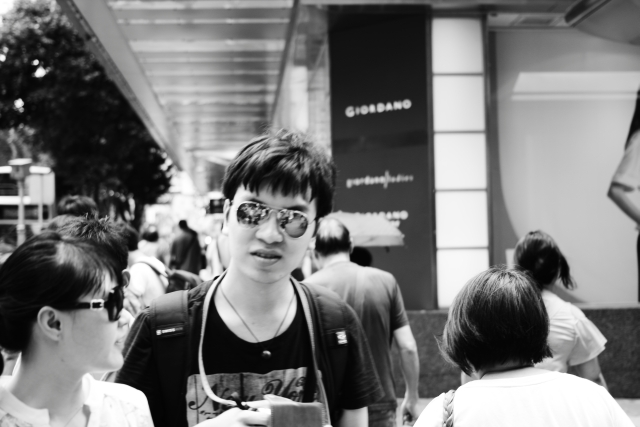
Behold the Fuji X70

Yes, I usually succeed in not buying another camera. But this time it’s different. Of course.

It was either the Fuji X70 or Ricoh GR II.

dscf0032-640

It was Eric Kim’s review that made me go for the Fuji X70. It’s “a Ricoh GR with Fujifilm colors”. Fantastic!

This time I have my wife’s blessing, as I’ve convinced her that I need a digital camera for street photography at night, as I have 3-4 hours to kill while waiting for my son (as his designated chauffeur) on various evenings.

dscf0035-640

Here’s the obligatory “me and my shadow” shot.

dscf0042-640

There’s a whole genre of cat photography to be found on the web.

dscf0045-640

I’m trying my best to resist taking another shot.

dscf0047-640

I’m still not instinctively comfortable with the 28mm focal length – I’m too close this time.

dscf0049-640

Here, I’m slightly further away than I realized – the 2 men should have filled out the whole image. I’m still thinking in terms of 35mm.

dscf0051-640

The articulated screen allows me to be more stealthy – I can’t imagine doing this even with my Leica M6. Raising it to the eye would make me feel too conspicuous. Not to mention that fact that my usual ISO 400 film would not be fast enough given the lighting conditions.

dscf0053-640

The Daido-inspired (poetic?) blurry shot. I think I can get away with it because of the wonderful film simulation colours from Fuji.

dscf0054-640

The touchscreen framing via LCD approach does allow for various angles.

dscf0055-640

I could do the “spray and pray approach” as well…

I sense a new book project in the horizon … maybe I can convince my wife … one book project, one camera …
Buy my book!


Mundane Objects

I’m taking a break from street photography to look at mundane stuff.

IMG_20151201_0001 640

Stuff our eyes don’t normally focus on.

IMG_20151201_0002 640

But they do create an environment of sorts.

IMG_20151201_0003 640

Repeat something enough and it becomes a life.

IMG_20151201_0004 640

Pavements can be interesting.

IMG_20151201_0005 640

Stuff lying around.

IMG_20151201_0006 640

There’s an order of things here.

IMG_20151201_0007 640

A call to discipline.

Camera: Canon Prima Twin S

Film: Fuji Superia Venus 800

Thingification

What happens when you choose not to place people at the centre of things?

IMG_20150206_0010 640

It’s a bit unsettling when humans are placed at the periphery.

IMG_20150206_0011 640

We cannot help but still do so – the above is still a photograph about human activity.

IMG_20150206_0013 640

Keyboards are for hands, pedals for feet.

IMG_20150206_0017 640

We love our things.

IMG_20150206_0021 640

We frame ourselves with things.

IMG_20150206_0024 640

We wait for things.

IMG_20150206_0025 640

We work with things.

IMG_20150206_0023 640

We are things.

IMG_20150206_0016 640

Some things out-wait us.


Camera: Spotmatic F

Lens: Super-Multi-Coated Takumar 35mm F 3.5

Film: Fujifilm Superia Venus 800

Things As They Are

Wallace Stevens: “You have a blue guitar,/ You do not play things as they are.”

IMG_20150206_0002 640

I suppose the whole point of the visual arts is to get us to see things as they otherwise are.

IMG_20150206_0003 640

And perhaps be unlikely.

IMG_20150206_0005 640

Wallace Stevens: “Things as they are/ Are changed upon the blue guitar.”

IMG_20150206_0006 640

This is not a bicycle.

IMG_20150206_0012 640

This is not a ladder.

IMG_20150206_0015 640

These are not sacks waiting to be moved.

IMG_20150206_0018 640

Things as they are not are directions and lines of force.

IMG_20150206_0019 640

Things as they are not are relationships between lines, textures, and light.

IMG_20150206_0020 640

With things as they are not, we learn the background of things.


Camera: Spotmatic F

Lens: Super-Multi-Coated Takumar 35mm F 3.5

Film: Fujifilm Superia Venus 800


Notes to Self

The past few posts have been about Occupy Central.

After all, we could only occupy what’s central to our hearts.

This post is a change of pace.

IMG_20141024_0003 640

I’ve talked about a few sights on the campus where I work in this post.

It’s a 20-minute walk down the hill from my office and it gives me time to think about what I’m doing and where I’m going in terms of my poetry, photography, research and teaching.

IMG_20141024_0001 640

We all need space to dwell and grow.

I’m grateful to be where I am, in an unpretentious and authentic space, in service of a community I feel committed to.

IMG_20141024_0010 640

Once in a while, you need to be empty in order to be filled.

So yes, I’ll need to fill up that container eventually (figuratively speaking).

IMG_20141024_0011 640

And find a sense of balance.

Sometimes, I take a 5-minute detour and I’ll see this on my way home.

IMG_20141024_0004 640

That red flower is beautiful, but it is beautiful not in itself, but in where it is.

IMG_20141024_0012 640

And 5 minutes later, I’ll see this.

IMG_20141024_0013 640

We swim in the pond in which we find ourselves.

And in every moment there is a painterly harmony to be sought.

This is what I’m looking for in my photographs and in my work in general, and what I’m looking for in myself.


Camera: Leica M6

Lens: Voigtlander 35mm F 1.4 Nokton Classic SC

Film: Fuji Natura 1600


Street Photography with my Leica M6

Street photography is to some extent about the art of making do.

I tend to think that street photographers are in the same category as street musicians, street performers and street hawkers.

There is technique but it’s the kind of technique shaped by being immersed in a specific environment, rather than one accrued by looking at charts, manuals, and pixels on computer screens.

I am in many ways reassured by David Gibson’s comments in his book The Street Photographer’s Manual, in which he says: “My technique is to get technique out of the way so that I can take pictures” (pg. 36).

He talks about respected street photographers who use the P mode (and cracked a photographer’s joke about “P” being the professional mode).

IMG_20140903_0001 640

This is the view from my office window – what I like about it is the contrast between nature (the hill) and the man-made (the air-conditioning whatchamacallit box-thing sticking out).

IMG_20140903_0004 640

I pay attention to composition, once I get the thing with the aperture/shutter speed and focus out of the way.

IMG_20140903_0005 640

So, buying a new lens for my Leica M6 provokes a crucial question about technique: what could a 35mm lens do that my 50mm Summicron couldn’t?

IMG_20140903_0006 640

If you have a 50mm lens, take 2 steps back and you have a 35mm lens… that’s street wisdom.

But a 50mm lens gives me that reach, as when I’m trying to capture part of a building, as in above.

IMG_20140903_0011 640

Or when I’m taking a picture like the one above. (Could you guess where I was?)

All photos above are taken with my 50mm Summicron Type II lens.

The rest below are with my newly acquired used Voigtlander 35mm f/1.4 Nokton Classic SC, which I think of as a budget (relatively speaking in Leica land) “old-school” lens for Leica film shooters.

All images from this post are from the same roll of film: Fuji Neopan 400CN.

IMG_20140903_0014 640

Was it money well spent?

Well … I couldn’t have taken the above shot otherwise, unless I take 2 steps back, which would have placed me in the path of traffic at Nathan Road at Tsim Sha Tsui during rush hour.

IMG_20140903_0015 640

I would have captured a smaller portion of the building above.

IMG_20140903_0016 640

Ditto.

IMG_20140903_0030 640

Ditto.

IMG_20140903_0019 640

Ditto at Shamshuipo.

There’s a hard-edged feel to the above that I like.

IMG_20140903_0021 640

I was trying to capture both people and buildings. The light wasn’t so good that day.

IMG_20140903_0037 640

This was on another day, with better light.

IMG_20140903_0035 640

Hmm… this brings me back to 1960s newsprint…

IMG_20140903_0031 640

Somehow the composition looks complete.

IMG_20140903_0032 640

The f 1.4 aperture means I could do some indoors street photography…

IMG_20140903_0034 640

Can you guess how the above was done?

Hint: it’s not double-exposure, and I don’t use Photoshop.

So anyway, I hope I’ve convinced you (and myself) why that 35mm Voigtlander lens was necessary.

Now that I have 2 lenses, what’s missing of course is another Leica body.

Perhaps a Leica M4 body might be a good backup/variant for the M6… which means I could do a double Leica combo on the streets…

Thanks for reading, and check out my Saatchi Art page!


A little bit of GAS (Gear Acquisition Syndrome)

So … I’m back from Shanghai, having tasted the power of a 50mm lens (80mm with a 1.6 crop factor).

What would that 40mm pancake lens I’ve been reading about do? Hmm…

_MG_9343 640

That 600D has been hiding away in my closet for a long time, and now I’m beginning to think that with a small-sized lens, it might be a good street camera.

_MG_9344 640

A 40mm would be a bit extravagant if you already have a 50mm lens.

Just zoom with your feet, I’d say.

But given the crop factor, it would mean 64 mm, a justifiable difference from 80mm.

_MG_9345 640

So, yes, I headed off to Tsim Sha Tsui with the intention of not buying that Canon 40mm F2.8 pancake lens.

_MG_9346 640

According to the Canon HK site, it goes for HK$1480.

I inquired about the price at Suning and the staff whispered HK$1380 conspiratorially.

_MG_9347 640

I crossed the road and went into a small shop called Echo Audio and it’s HK$1100.

Yes! I made some money! A yummy pancake!

_MG_9350 640

Roland Lim has a lot to say about buying cameras in Hong Kong.

Beware of those shops with “Tax Free” signs. Consumer goods are tax free everywhere in Hong Kong.

_MG_9352 640

I’ve always been mindful of GAS (Gear Acquisition Syndrome).

_MG_9353 640

Every time something fascinating appears, I remind myself it’ll be old news a year later.

First there’s Sony RX100, followed by RX100 MII, and now it’s RX100 MIII.

Ditto Fuji X100 and X100S. You can’t keep up.

_MG_9354 640

I’m mindful of planned obsolescence when it comes to digital cameras – that’s partly why I’m into film cameras.

_MG_9355 640

A Leica M6 would still be majestic 10 years later and hold its value at least on EBay.

You can’t quite say the same with digital cameras.

_MG_9358 640

So anyway, a 64mm would fit between my Leica 50mm Summicron and that 80mm (50mm Canon nifty fifty).

_MG_9360 640

I could be indoors and still be unnoticed despite the loud flipping of the slr mirror, given the distance.

_MG_9361 640

This person spotted me but carried on as before.

The pancake is not as intimidating, compared to if I had my 18-135mm lens.

_MG_9362 640

The fact is, no one noticed me.

The 600D with the pancake looks really small. (Though it is a bit loud).

_MG_9363 640

He didn’t even look up.

_MG_9364 640

Maybe I look like a tourist with a camera, in a tourist area.

_MG_9365 640

He spotted me, but went on walking past me.

_MG_9372 640

I’m in the MTR (subway) and no one stopped me.

_MG_9376 640

I am invisible…

_MG_9379 640

My camera looks like a toy.

_MG_9382 640

Do I exist?

_MG_9385 640

If I take a picture and no one sees me … do I exist?

_MG_9386 640

People are too immersed in themselves…

_MG_9390 mono 640

Too immersed in their phones…

_MG_9426 640

Finally – someone noticed!

Thanks for reading!

And if you like this post, you’ll like my portfolio.


Anecdote of the Jar

I’m not sure if this is considered street photography, but I suppose so, if street photography is about scenes that are found rather than staged, about scenes that say something about the interactions between human beings and their environment.

For those interested in film photography: all photographs are taken with Contax TVS, loaded with Superia Venus 800. That’s the gear I carry these days. This post is inspired by Wallace Stevens’ poem, “Anecdote of the Jar”:

I placed a jar in Tennessee,

And round it was, upon a hill.

It made the slovenly wilderness

Surround that hill.


The wilderness rose up to it,

And sprawled around, no longer wild.

The jar was round upon the ground

And tall and of a port in air.


It took dominion everywhere.

The jar was gray and bare.

It did not give of bird or bush,

Like nothing else in Tennessee.


A quick Google search will reveal various possible readings to the poem, so I’ll suppress my inner poetry geek as much as I can.


I’ll simply say that at the minimum, the poem is about the relationship between human artifacts and nature.


The take-away philosophical point is that a man-made object placed/installed in nature changes nature.

IMG_20140526_0005 640

Is nature a rubbish dump, a depository of things no longer useful?


The joker in me tells me it’s a supermarket shopping cart that has lost its way.

IMG_20140526_0008 640

Nature is nature.


A journey into what nature is is man-made.

IMG_20140526_0009 640

Is nature a resource we exploit?


I am reminded of the following lines from Heidegger’s essay “The Question Concerning Technology’ , about how our instrumentalist attitude to nature (and everything else) reduces everything into a “standing-reserve”, as means for other ends:


Everywhere everything is ordered to stand by, to be immediately at hand, indeed to stand there just so that it may be on call for a further ordering. (Heidegger “Question Concerning Technology”)

IMG_20140526_0019 640

We’ve learnt to frame nature.

IMG_20140526_0026 640

And in our arrogance, we forget it is nature that frames us.

IMG_20140526_0027 640

Perhaps we’re the ones putting obstacles between ourselves and nature, between ourselves and ourselves.

Continue reading “Anecdote of the Jar”