Mongkok

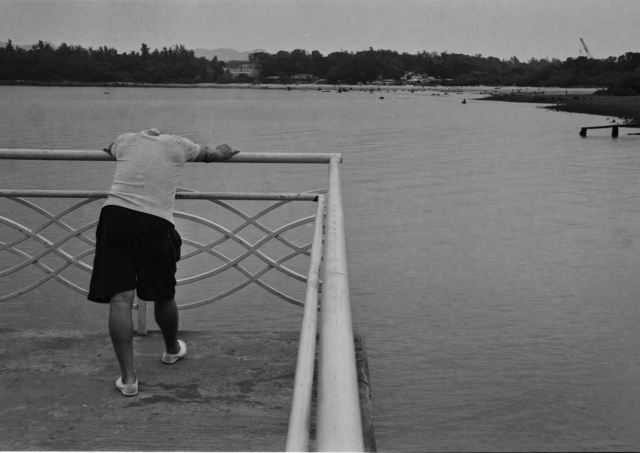
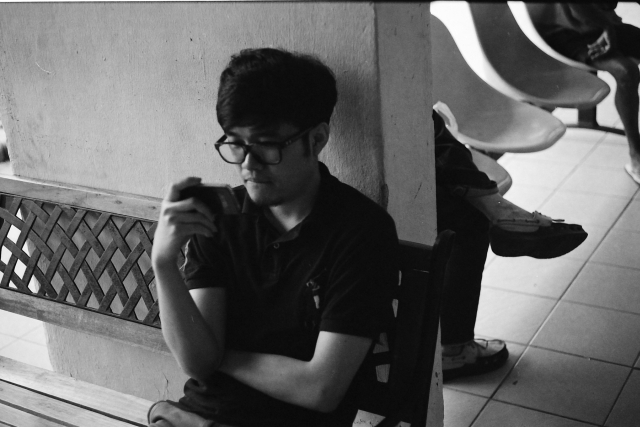
Again, I find myself wandering around in Mongkok.

IMG_20140121_0021 640

I find that the side streets parallel to Nathan Road are more conducive to street photography.

IMG_20140121_0005 640

The pace is slower, it’s less crowded and so you can see further and anticipate, unlike the pavements on both sides of Nathan Road on weekends or during rush hour.

IMG_20140121_0001 640

For the above, I zone-focused, snapped and turned around without even stopping.

Yes, it’s my Olympus XA2 again, loaded with Ilford XP2 400. It’s so small once you remove the flash.

So it’s always with me.

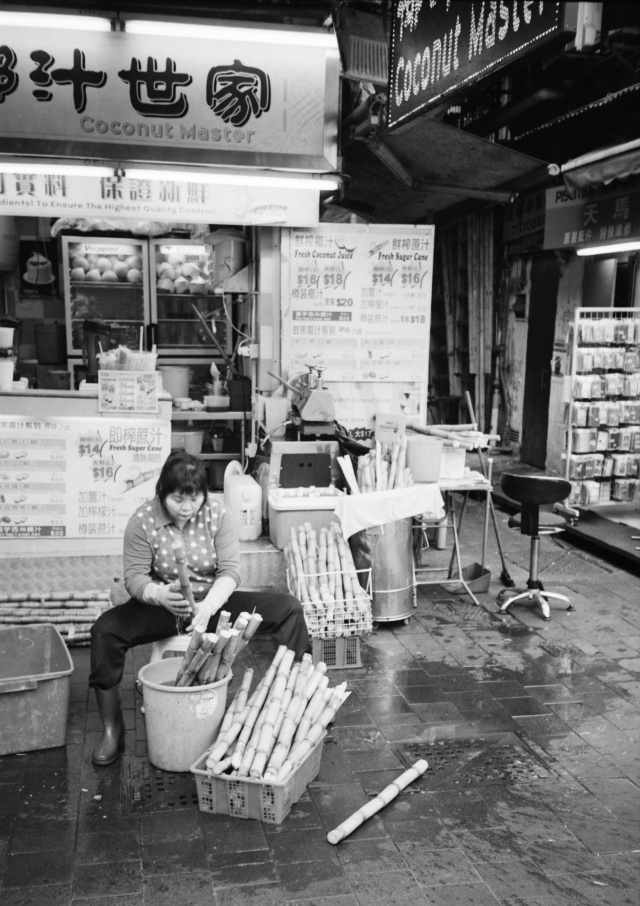
There’s yummy sugar cane juice at the coconut master’s shop.

IMG_20140121_0006 640

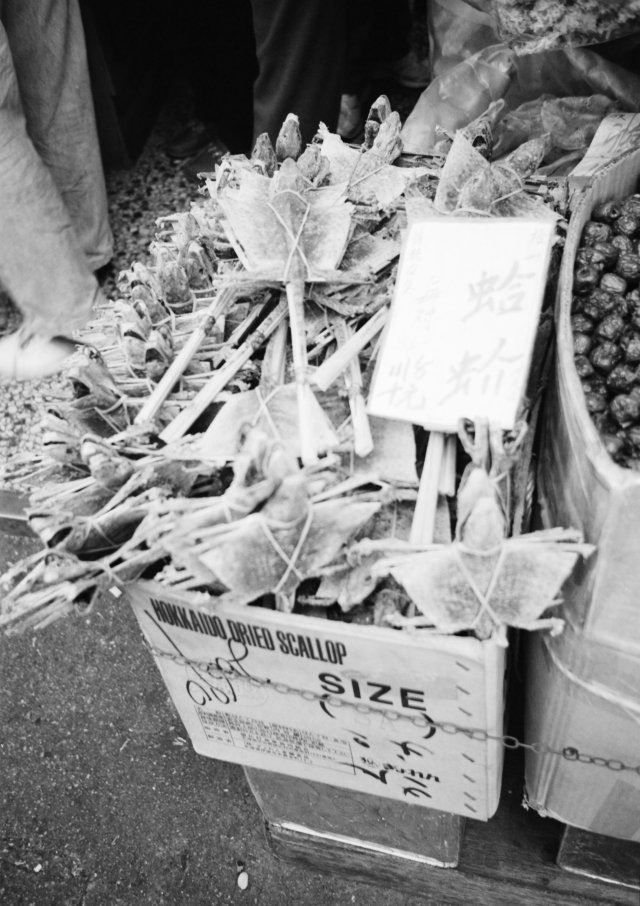
There’re quite a few shops selling traditional Chinese foodstuff along Woosung Street.

They sun some of their goods on the street…

IMG_20140121_0010 640

IMG_20140121_0009 640

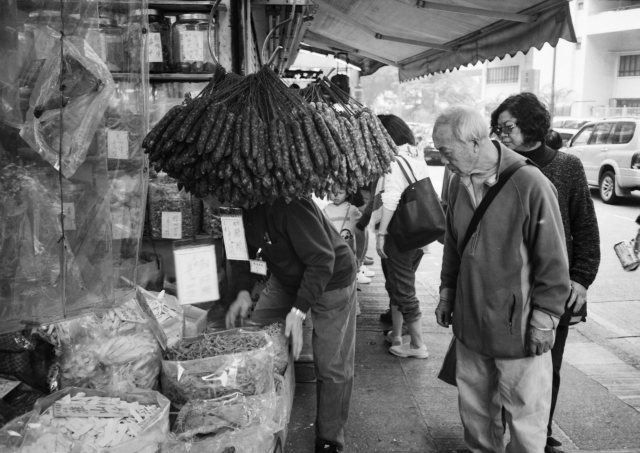
There’re lots of people in this particular shop.

So I hung around outside for a bit.

IMG_20140121_0003 640

IMG_20140121_0012 640

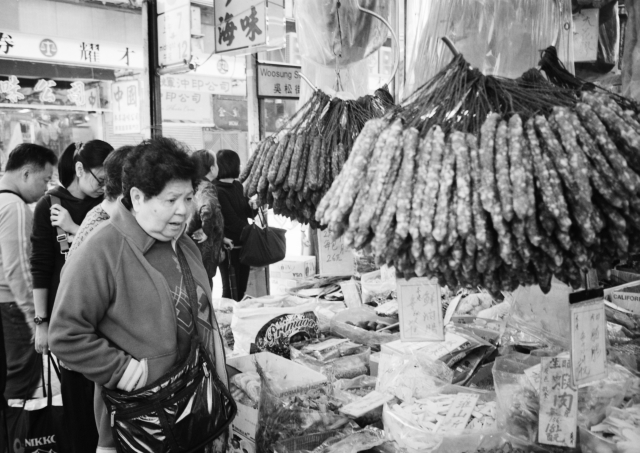
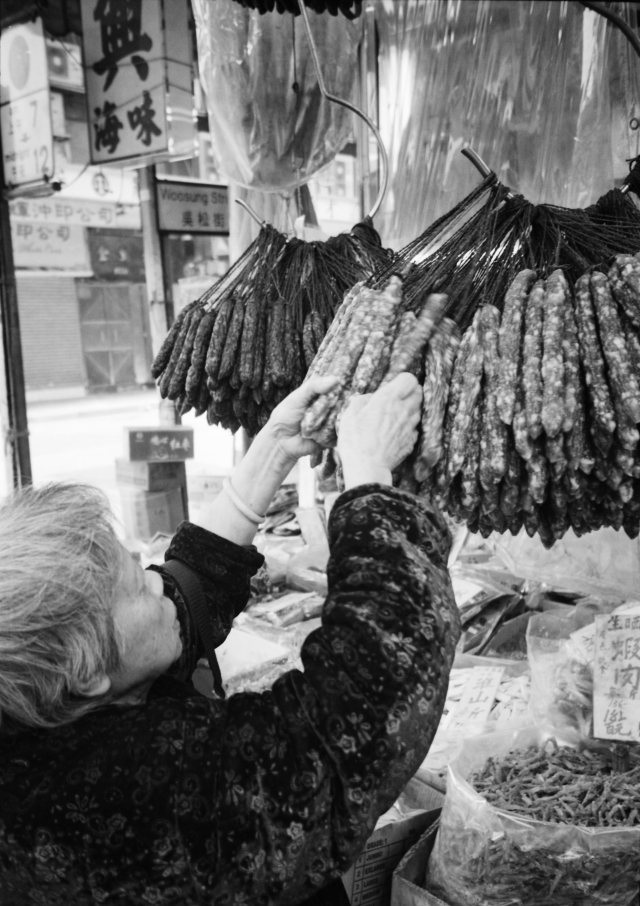
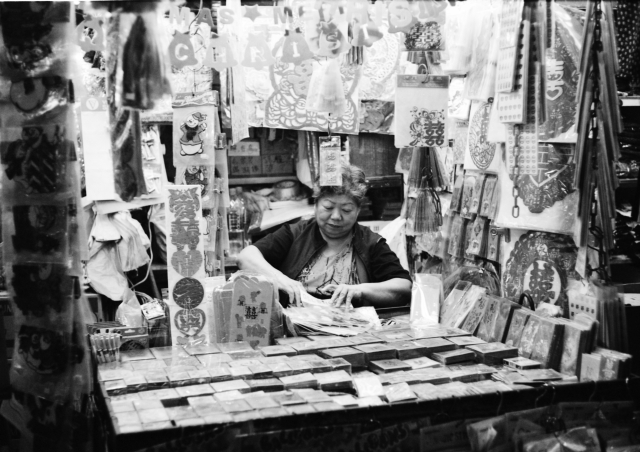
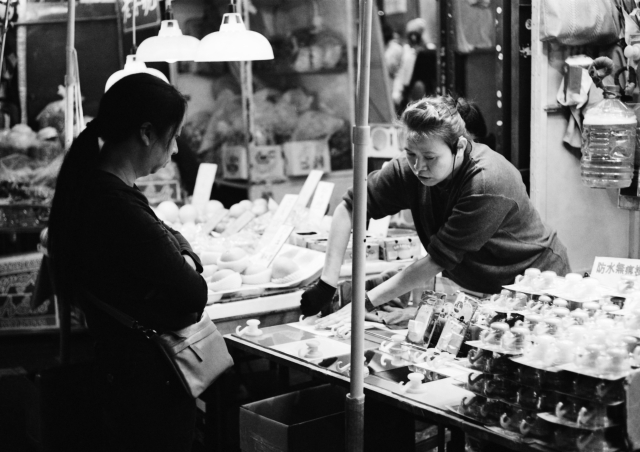
This por por in the photograph below took some time to select the lap cheong (Chinese dried sausage).

So naturally I took a few shots of her.

IMG_20140121_0007 640

She suddenly turned around and said in Cantonese, “Oi, handsome, are you done? The hook is too high.”

So naturally I obliged.

Street photographers are supposed to fade into the background, but I suppose it’s hard to do so for me given my looks …

😛

IMG_20140121_0014 640

Thanks for reading!

Singapore Zoo

Yet another set of street photographs taken at in-between moments during a family outing at the Singapore Zoo a few months ago.

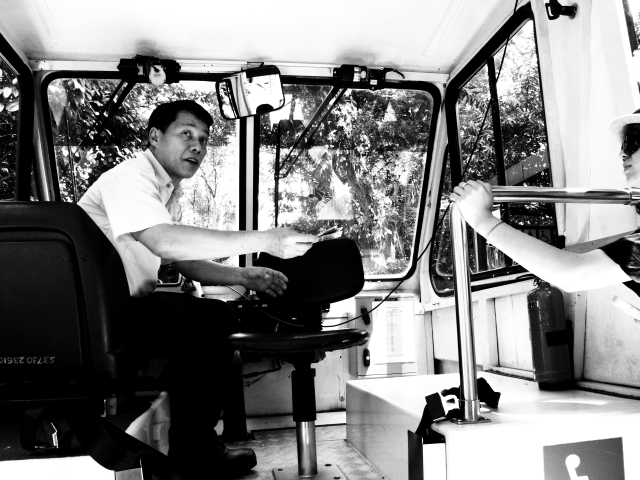
That’s our friendly and helpful tram driver.

IMG_5785 640

My son loves the pony ride.

I am a very talented photographer – through telepathy, I’ve managed to convince the person in the background to bend a little bit so as to be confluent to the pony handler’s face and shoulder outline.

IMG_5833 640

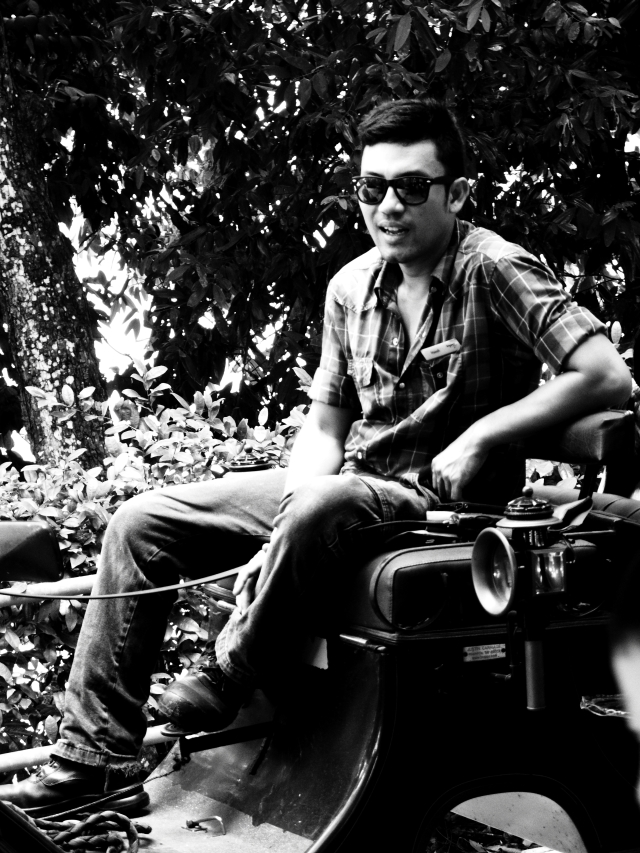
Here’s the horse carriage driver.

IMG_5858 640

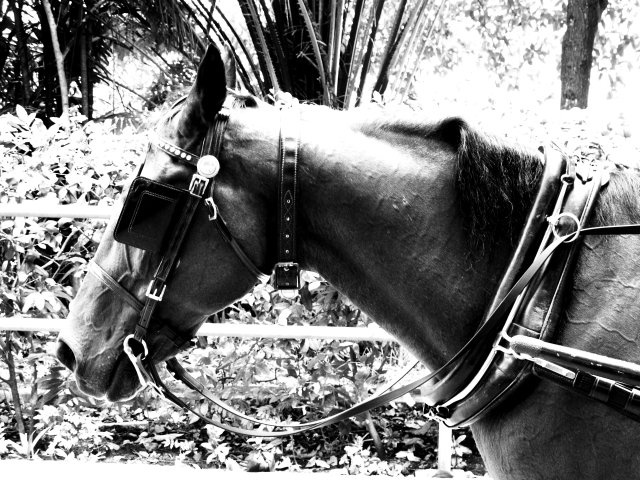
Here’s the horse.

IMG_5862 640

It’s interesting how high contrast monochrome changes things. The photographs look somewhat hard-edged and menacing at times …

Go to the zoo if you’re ever in Singapore. It’s really not so menacing …

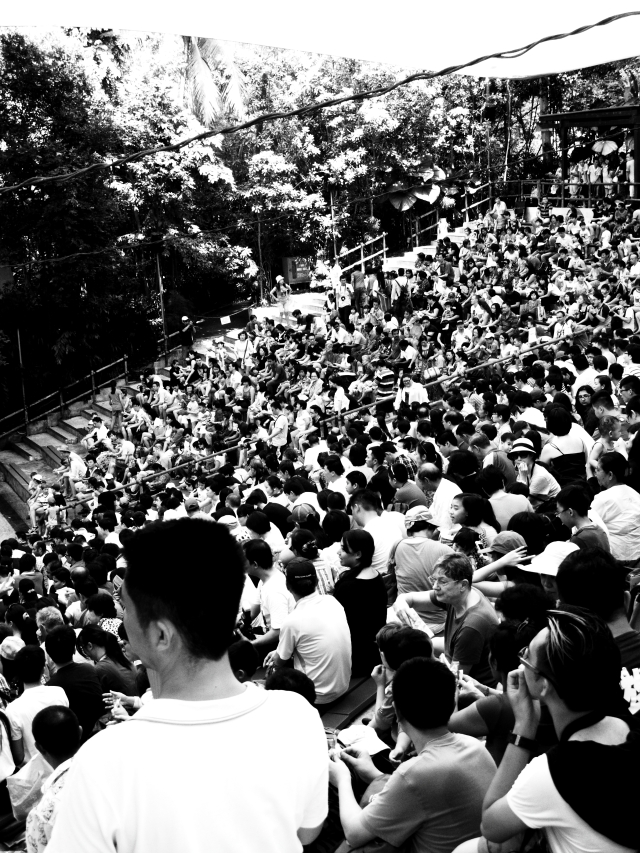
The crowd at an animal performance show.

We go to the zoo every time we’re back in Singapore.

So, I’ve seen the performance many times.

Now, instead of looking at the performance, I look at the crowd and think about how to photograph the human exhibits.

I am a very talented photographer – using telepathy, I’ve managed to convince a stranger to stand up so as to create a contrasting element to the crowd.

IMG_5800 640

That’s err… a bird animal creature with two legs and feathers…

IMG_5797 640

I suppose that’s my nod to Gary Winogrand‘s The Animals.

Thanks for reading!

Sentosa Snapshots

I’ve been looking though images taken a few months ago in Singapore with my trusty Canon G11. It went through an overhaul and is now good as new.

Generally, on family outings, I bring along my G11 for family snapshots.

Usually, I make a division between street photography (film cameras only) and family pics (digital only) just to keep things simple. But life is not always simple.

I find myself in street photography mode often at various moments during family outings.

These were taken at Sentosa.

IMG_5744 640

I find the high-contrast Daido Moriyama style rather addictive.

IMG_5770 640

The scene looked so good I can’t resist another:

IMG_5771 640

I’m still waiting for my G11 to break down so as to have an excuse to get that Ricoh GR Digital.

More next time.

The Camera as Sketchbook

I’m prepping for a talk on my manuscript in progress which features street photography and poetry.

In some ways, the camera has become my sketchbook.

Here’s Henri Cartier-Bresson from The Mind’s Eye (and the first part of the book is titled “The Camera as Sketchbook”):

For me the camera is a sketch book, an instrument of intuition and spontaneity, the master of the instant which, in visual terms, questions and decides simultaneously. In order to “give a meaning” to the world, one has to feel oneself involved in what one frames through the viewfinder. (The Mind’s Eye pg. 15)

For the street photographer, the camera is a tool for thinking …

Here are some of the photographs I’ll be talking about, the first of which has been featured in a previous entry.

They are each paired with a poem in the manuscript.

I’m only including fragments of the accompanying poems here.

IMG_20130830_0004 640

*

“how hong kong works, no one knows,
though everyone says mm goi, mm goi,
thank you, small favour, another name
for waiter, excuse me, help.”

*

IMG_20130307_0033 640

*

“one can only be a tourist
constantly taking pictures

posing and making sense”

*

IMG_20130813_0029 640

*

“i tell myself i am a camera
though i am a camera trying to be a man

because a camera captures everything
and is nothing in itself.”

*

What they have in common: they’re about looking at the act of looking. In a way, these are photographs of myself…

Thanks for reading.

The Art of Life

I’m planning to use the following quote for a talk on poetry and photography for fellow writers.

It’s from Zygmunt Bauman, a sociologist who has written on what he calls “liquid modernity”. This passage from his book The Art of Life is relevant to those who are on the quest for meaning:

To practise the art of life, to make one’s life a “work of art”, amounts … to being in a state of permanent transformation, to perpetually self-redefine through becoming … someone other than one has been thus far. (The Art of Life 73)

I now have the habit of bringing along one or two film cameras wherever I go. It’s usually a Leica M6, paired with either a Yashica GX, Canonet QL 17 Giii or more recently, the Olympus XA2.

The Olympus XA2 is really stealthy because of zone-focusing. And it’s really quiet too. For example, I could do this in a cab without the driver noticing:

IMG_20131024_0005 A3 A4 640

Try that with a Canon 5D Mark III.

Part of my fascination with film cameras has to do with their longevity – digital cameras either go out of fashion or break down after 3-5 years (though it has to be said that my Canon G11 is still going strong). The Olympus XA2 was made in the 1980s, which means the thing in my hand is about 30 years old.

I guess I am now using my cameras as a sketchbook of sorts, storing material for writing and thinking. This is probably a little too deliberate, but I think of this as pushing myself beyond what I am, “becoming someone other than one has been thus far”, asking street photography to teach me to be a better writer and thinker.

For now, the art of life for me is about storing moments which might otherwise seem artless.

Lately, I have begun to take pictures with only my eyes, imagining what a scene would look like on a photograph… click… click…

And I like this quote from William Todd Schultz, who wrote An Emergency in Slow Motion: The Inner Life of Diane Arbus, a wonderful psychobiography of Arbus:

Artists aren’t always in complete command of their material. Sometimes it commands them and they let it; they get out of the way, the subject matter comes unbidden, it compels them and they follow its lead.

This might be a careless comparison, but Arbus is to photography what Sylvia Plath is to poetry.

And as for material for the street photographer, there’s often poetry to be found in places you least expect, which is why that tiny Olympus XA2 is so handy:

IMG_20131024_0024 A3 A4 640

The above is just next to where I live, a plot of land on which a small shopping mall is being built. *sigh*

I’m always fascinated by how one could be in a built-up area in Hong Kong, and after walking for 20 minutes, be in the midst of idyllic village houses where clothes are hung in open air and kitchens are next to public walkways:

IMG_20131024_0042 A3 A4 640

IMG_20131024_0043 A3 A4 640

And then, 10 minutes later, one is at the beach.

IMG_20131024_0065 A3 A4 640

IMG_20131024_0066 A3 A4 640

And you would come across scenes like this:

IMG_20131024_0067 A3 A4 640

This is Wu Kai Sha beach, and there’re now plans for land reclamation in the area which would mean the beach would be no more… *another sigh*

Thanks for reading.
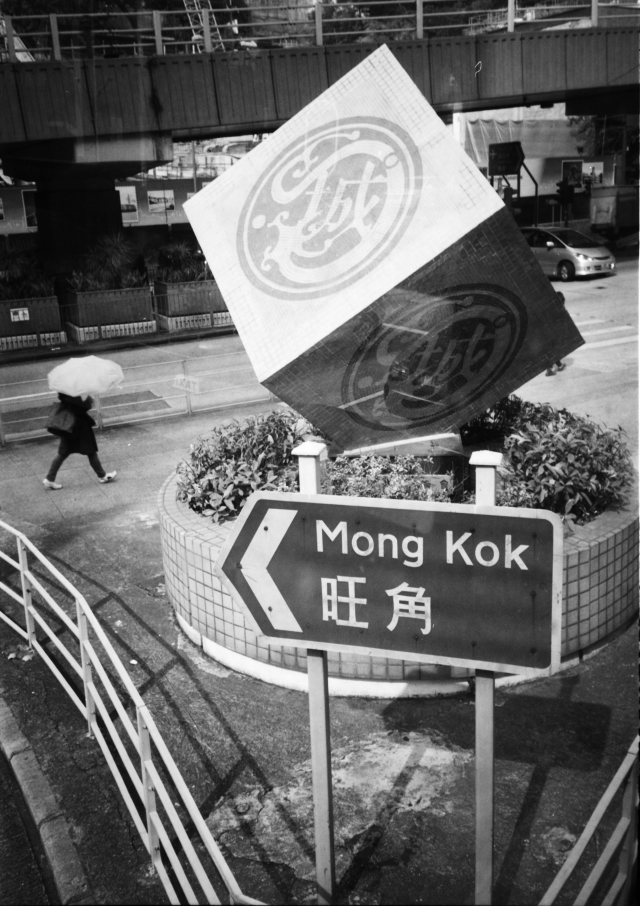
Ode to Public Laundry

I guess this is a common sight in quite a few places in Hong Kong:

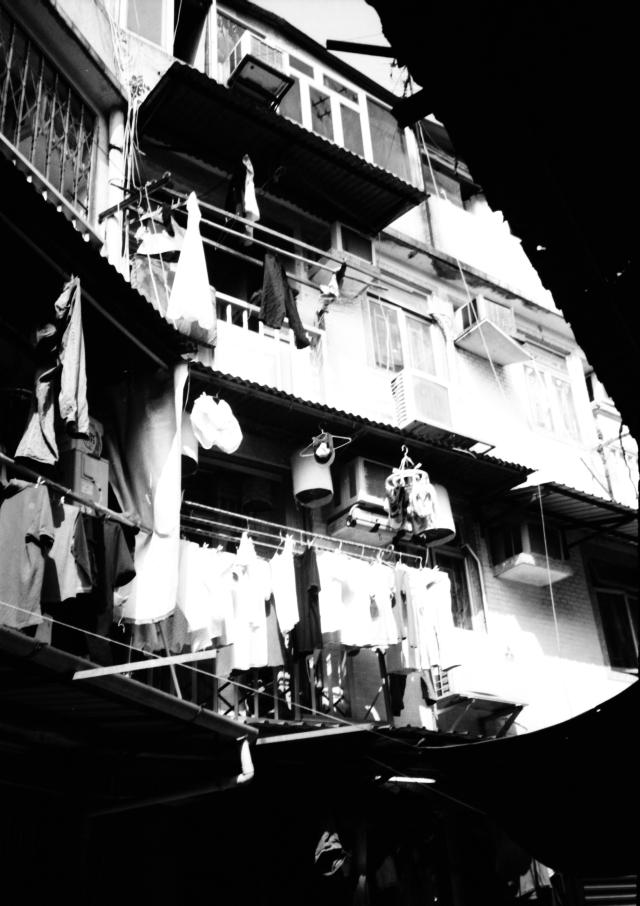
IMG_20131010_0038 A3 A4 640

On the one hand, there are those who say this is unsightly, and that there should be awareness campaigns against airing/drying one’s laundry in public.

After all, it looks too much like a ghetto, and is offensive to middle-class tastes.

(It might bring down property prices.)

IMG_20131010_0043 A3 A4 640

On the other hand, it speaks of the “can do” spirit of people, who make do with tiny living spaces in Hong Kong.

There is a kind of symphony here of public laundry.

IMG_20131010_0039 A3 A4 640

There is a kind of charm in the way the clothes are being hung… perhaps there is a sense of community here in the way the space is being shared.

Not everyone has dryers at home… and after all, clothes dried in the sun has the smell of sunshine in them.

IMG_20131010_0062 A3 A4 640

And sometimes, it can get a little creative:

IMG_20131008_0044 A3 A4 640

There are public spaces. There are private spaces.

And perhaps there are in-between shared social spaces with streets that are peopled even if there are no people around…

Monochrome Poetry

Photography is … visual. That much is obvious. As a published poet and literature professor, I’m supposed to be able to convey ideas with words but what happens when something is a visual idea?

This would take us from visual to verbal to visual again. And the first and last visual may not be the same, even though we’re talking about the same photograph.

I look and look and understand how a photograph works, but I’ve yet to properly learn how to say why it works and why I enjoy it.

Photography has made me rethink some of those things to do with literature that I’ve forgotten. Of course, the experience of a literary work is not the same thing as a book review or a scholarly paper.

The experience … the experience … the horror … the horror … the “oomph” … it starts with the experience, and sometimes I feel like all one has to do is to read and look and be quiet. That was the experience of reading in my youth which put me on the path of academia.

The subjective “oomph” comes first. All the bits about literary/intellectual history, the meaning of meaning and so on, comes after.

This explains why my colleagues down the corridor could spend so much time on books that I genuinely find boring and pointless … and of course, vice versa.

Anyway, back to what is visual “oomph”, at least for me:

IMG_20131008_0019 A3 A4 640

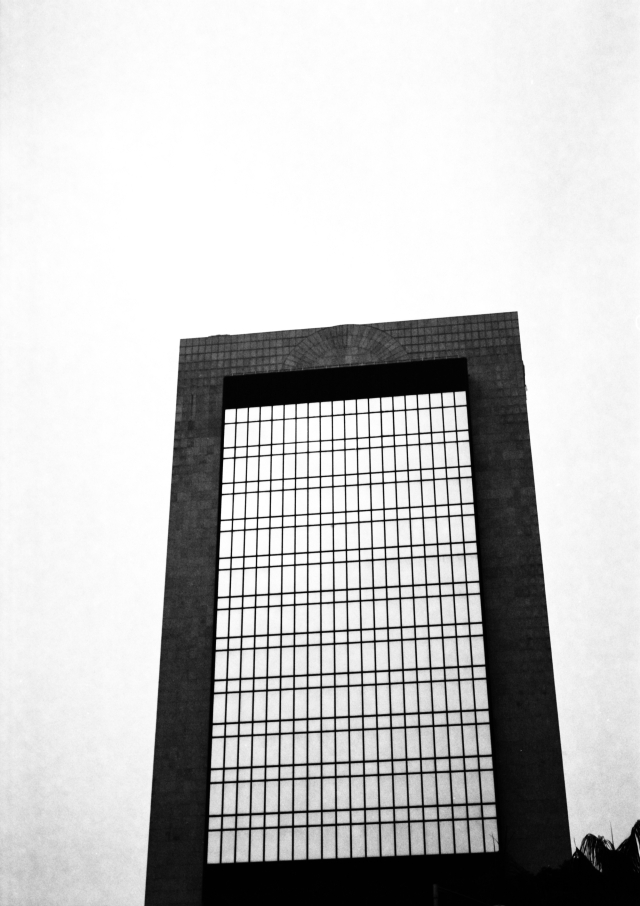
That’s the Leisure and Cultural Services Headquarters at Shatin. Perhaps this is what the Ministry of Truth looks like in Orwell’s 1984.

IMG_20131008_0008 A3 A4 640

The mini-bus and high-rise apartment buildings. So very Hong Kong. This is at the elevated bus interchange just outside New Town Plaza, the hard-to-miss shopping mecca at Shatin.

IMG_20131008_0020 A3 A4 640

Walk down the sloped pavement by the side onto ground level and you’ll see an entire length of village houses, some of which have been converted into eateries.

IMG_20131008_0023 A3 A4 640

That’s just below the bus interchange, right next to more mini-bus terminal stops. I like the different greys of the pavement…

IMG_20131008_0021 A3 A4 640

Yet another village house … with a gothic feel.

All these images are taken from within 200-300 metres. That’s how packed Hong Kong is. Keep in mind this is the urbanised area of the New Territories, third in line in terms of urban development, coming after the Kowloon/Tsim Sha Tsui areas and the Central/Wanchai areas on Hong Kong Island.

Thanks for reading.
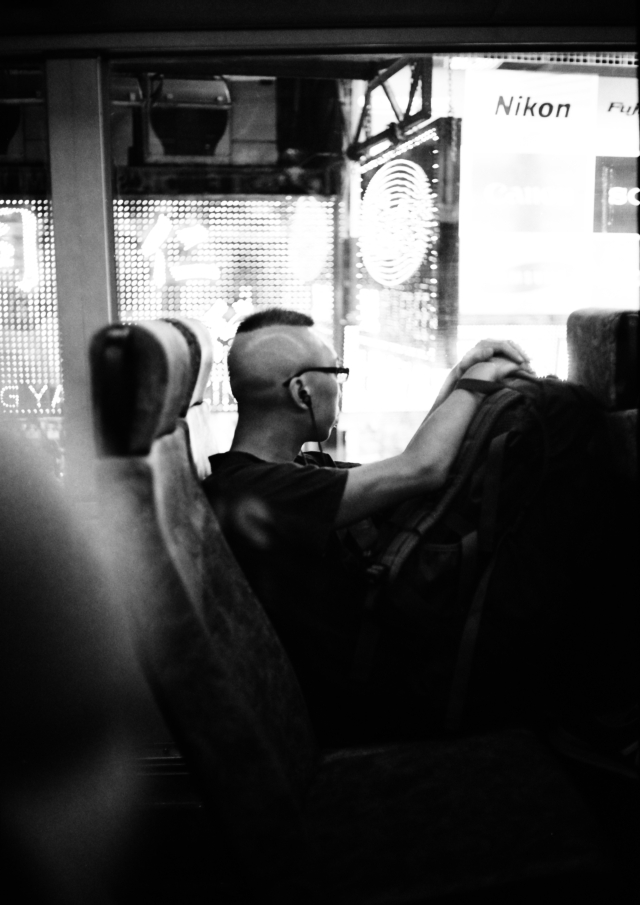
Fa Yuen Street Market

Night photography poses a challenge for any photographer.

Even with a digital camera, you’ll need a wide aperture, longer exposures, perhaps a tripod, or image stabilization if you’re doing it handheld, and you’ll need to have a high ISO setting.

Auto-focus might be a problem if it gets too dark, as a digital camera may not be able to find a focal point quickly enough.

So if you’re a street photographer with a film rangefinder loaded with Ilford XP2 at ISO 400, the odds are somewhat stacked against you at night. This is one of those times when you wish you’d caved in and bought that Fuji X100s.

A street market at night, as it happens, is one of those wonderful scenarios where everything comes together.

As the light bulbs are bright, you’ll have natural vignetting. The goods might have been arranged to form a perfect frame within a frame.

IMG_20130918_0010 A4 640

IMG_20130918_0013 A4 640

The stall hawkers, even when they spot you, would be too preoccupied with selling their wares to their customers, while the customers’ attention would be on those wares.

IMG_20130918_0012 A4 640

IMG_20130918_0011 A4 640

IMG_20130918_0005 A4 640

This person did spot me…

IMG_20130918_0003 A4 640

Oh well … and to challenge myself, this:

IMG_20130918_0015 A4 640

Thanks for reading.

near Ma On Shan Central Park

Adjacent to Ma On Shan Central Park, facing Tolo Harbour, is a homely stretch.

On a leisurely weekend, you’ll find joggers, sunrise/sunset photographers and people simply out for a walk.

IMG_20130311_0012 640 by 480

I’ve underexposed these shots, and realized one could transform the homely and familiar into something uncanny, slightly gothic and perhaps even frightening.

IMG_20130311_0027 640 by 480

I think it has to do with seeing and not being able to see. Simply by playing with light, one could change things.

IMG_20130311_0015 640 by 480

That is why I think street photography is about “capturing” as much as constructing and playing with reality.

IMG_20130523_0040 640 by 480

Boo!

My Singapore

I was in Singapore recently and of course, I brought along my Leica M6 fixed with a 50mm Summicron.

I was paranoid at first about the film going through airport x-rays. But I could see no fogging to my beloved Ilford XP2 films on a previous trip despite them having gone through 4 x-ray cabin baggage scanners at the airport at HK airport, then at Dubai where I transited, and back again.

I took a walk around my neighbourhood and walked past him, circled around, and took this:

IMG_20130724_0018 640 by 480

This was at the National Library. I simply love this particular angle of the architecture:

IMG_20130813_0007 640 by 480

This was in Hans, the café at the library. I like the rectangular grid:

IMG_20130813_0006 640 by 480

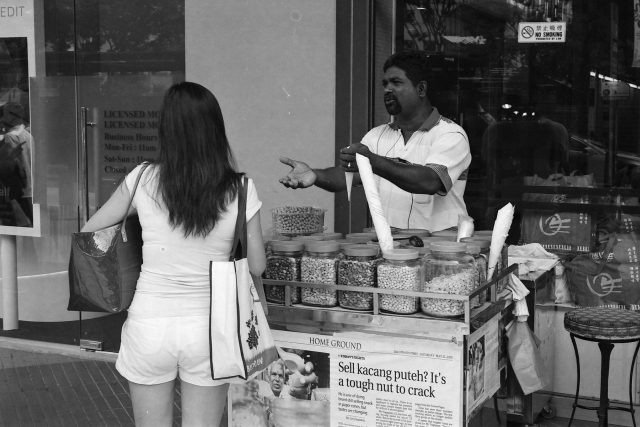
And yes, the kacang puteh man:

IMG_20130724_0035 640 by 480

You might say there’s a statement here waiting to be made about the life of a kacang puteh seller, as our attention is drawn to the newspaper headline the seller has put up.

And then I had my Singapore-style chicken rice here. They do it very differently in Hong Kong…

IMG_20130724_0036 640 by 480

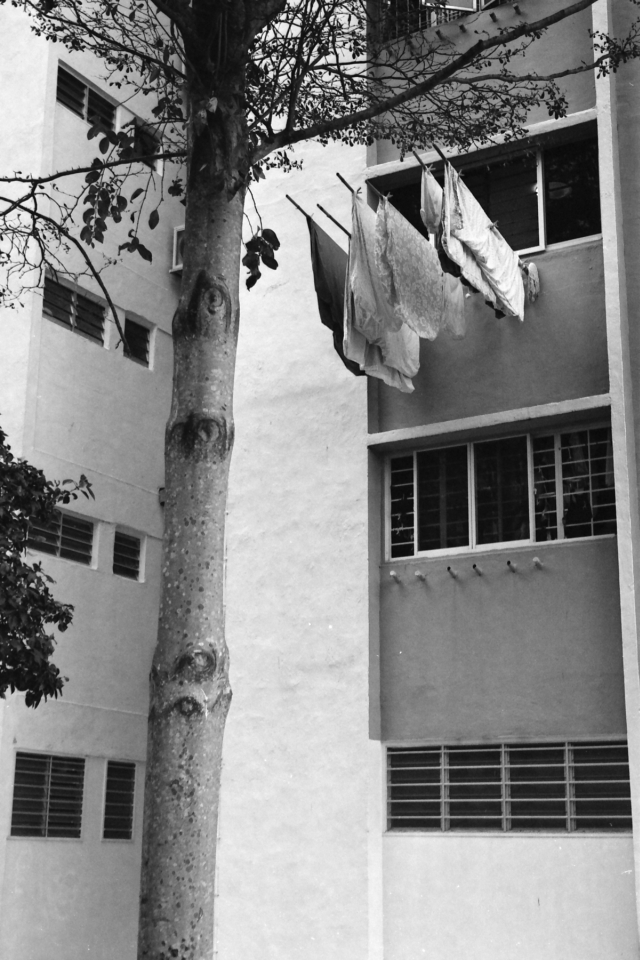
The photograph below sums up my ambivalent attitude towards my country of birth, in which I’ve spent 3/4 of my life before moving to Hong Kong. About 80-85% of the people live in public housing, and the facades of these HDB flats are often used as symbols of conformity, depicting the cookie-cutter and pigeonholed lifestyle and aspirations of middle-class Singaporeans. I have in mind those haunting images at the beginning of Eric Khoo’s 12 Storeys.

I think of the photograph below as saying something opposite.

IMG_20130724_0006 640 by 480

I like the tree here because it symbolizes something else, that perhaps there is life, rejuvenation and fresh insights that might arise. I sense a poem coming …

Finally, since some of my friends have been asking about my street photography and the point of it all, here’s an essay by Nick Turpin that says it.

I especially like this quote from Nick’s essay:

“As a Street Photographer you are different, you are not like the others, you are an oddity both in society and in photography. In society you are odd because you are just standing their [sic] looking whilst everyone rushes past to their next shopping experience or intake of salty, sugary, fatty food. In photography you are odd because your motivation is not financial and you don’t go to photo trade shows unless it’s to people watch. You are really not part of either world, it can be lonely not talking about equipment and bags and not oiling the wheels of retail….if it weren’t for online street photography forums you could feel isolated like some lonely eccentric.”

Sometimes I stop and look around and wonder where everyone is rushing off to…